Turn Off The Fake News and Let’s Get Real…Income

Real income from investments has been tough to find for the last few years. With banks currently offering just 0.15% for a six month certificate of deposit, ten year U.S. Treasuries paying 2.2% and longer term investment grade corporate bonds yielding 4%, the traditional choices of income producing sources are unappealing.

We offer a strategy for meaningful yield generated across multiple asset classes. The Absolute Yield portfolio invests in exchange traded funds (ETFs) to gain exposure across these asset classes, both in the U.S. and globally. ETFs provide diversification to reduce risk. The Absolute Yield portfolio’s volatility since inception in 2013 has been about 60% of the U.S. stock market.

What are these multiple asset classes? We use eight to ten stock, fixed income and alternative asset classes which tend to be non-correlated. No one class exceeds 20% of the portfolio. At this time, these asset classes are:

  • Common Stocks: global companies that pay high dividends
  • Business Development Companies: management companies that provide loans to smaller firms in their early stages of development, similar to venture capital firms
  • Real Estate Investment Trusts (REITs): firms that generate income from real estate rentals and transactions
  • Mortgage REITs: firms that derive income from investments in mortgages and mortgage debt
  • Preferred Stocks: hybrids between stocks and bonds, which receive dividends before common stock owners
  • Master Limited Partnerships: natural resource firms paying income from profits in developing, extracting, transporting and selling these resources
  • U.S. High Yield Bonds: bonds rated below investment grade from U.S. based companies
  • International/Emerging High Yield Bonds: bonds from countries which tend to have lower credit ratings due to increased economic and/or political risk
  • Senior Bank Loans: floating rate bank loans to non-investment grade companies, collateralized by corporate assets

The yields on the various asset classes are illustrated in the chart below:
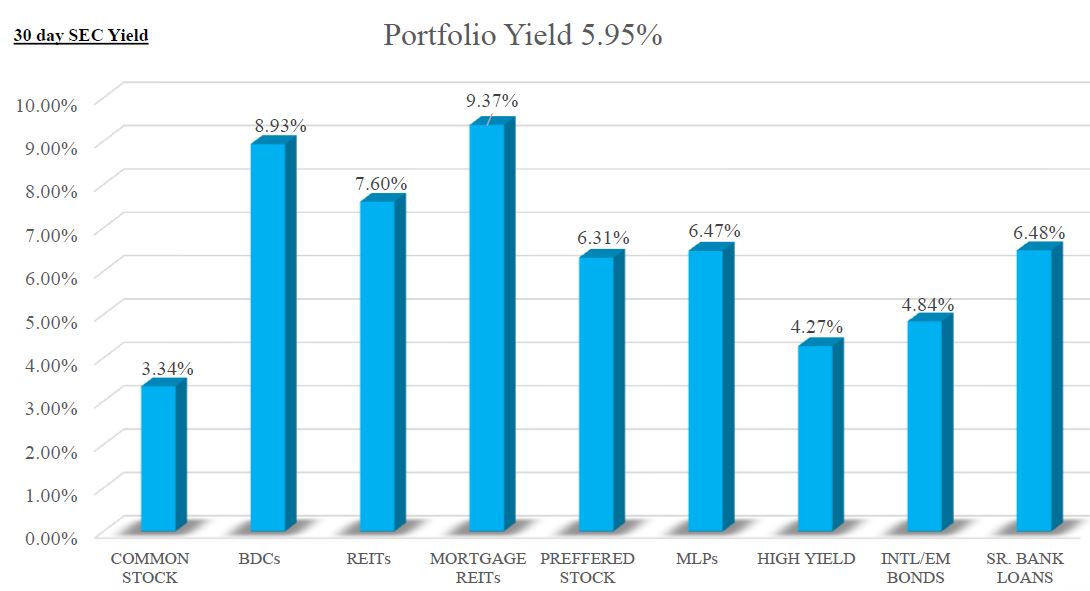
At the end of May, the Absolute Yield portfolio provided a yield of 5.95%.

As an actively managed portfolio, the Absolute Yield portfolio is constantly monitored by our investment management team for attractive opportunities to maximize yield with below average total volatility.

This is a proven strategy for investors willing to diversify from customary sources of fixed income. It is designed for people who can accept short term market fluctuations in an effort to boost income while seeking modest growth in the underlying assets over a full market cycle.

As always, it is important to keep your focus on the long term investment goals to which you are committed. Know your risk tolerance score, and continue to incorporate that into your investment program. Let time work on your behalf.

To expand on these Market Reflections or to discuss any of our investment portfolios, please do not hesitate to reach out to us at 775-674-2222
Posted on June 14, 2017 Read More

Headlines vs Bottom Lines

Market prices are a reflection of all things known and the collective wisdom of all things expected to be known. The market constantly evaluates all factors, be they fundamental, technical or political.

Corporate earnings is an example of a fundamental factor with long-term market price implications. The market pays very close attention to expected earnings and diligently compares them to actual results when reported. This dynamic plays out with every public company’s quarterly earnings release. Did they meet, beat or fall short of expectations and what is their sales and profit guidance for future quarters? Macro factors such as economic growth, employment, retail sales and consumer confidence can influence market prices. These economic fundamentals are also important components to long-term stock price movements.

In addition to fundamentals, world and political headlines can also impact price movements. These usually result in shorter-term price movements. In the recent past we saw this play out with the U.S. election night and the British vote to leave the European Union last summer.

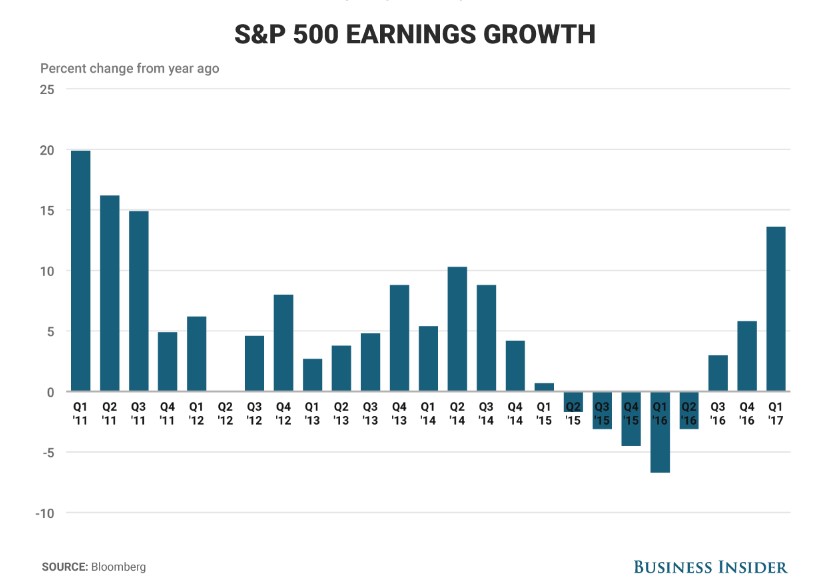
The struggle between headlines and bottom lines usually works itself out whereby fundamentals carry the day. Although, there are times in the battle where headlines take control. This was briefly evident in May as headlines began to weigh on the market. You have experienced this sensationalism before: “Stock, Dollar Fall Amid Turmoil in Washington”, “Dow Falls More Than 200 Points Following News of Comey Memo”, and “Fed’s Rate-Hike Odds Tumble After Washington Chaos Hits Bond Market”. International markets are not immune to headline risk as May gave us, “Brazil Markets Sink, Triggering Circuit Breaker on Fresh Crisis.” As an investor, your best defense is to tone down the headline noise and focus on the fundamentals. Put another way, don’t let the headlines of the day stir your financial emotions. Instead, pay attention to the evolution of the chart below and let this be your guiding light.

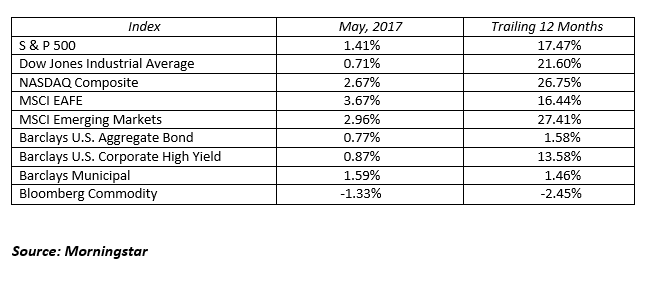
Despite all the political noise the markets not only survived another month, but reached new highs in the process. Best Buy and Costco proved retail is not dead yet, and Amazon reached an amazing $1,000 per share price. The NASDAQ 100, S&P 500 and the Dow Jones Industrial Average all hit new records even after the media’s best attempt to scare investors to death after just one down day. At the end of the month it was the international developed stock group taking home the first place trophy with a return of 3.67% followed closely by emerging market stocks and the NASDAQ Composite with monthly returns of 2.96% and 2.67%, respectively. We welcome June with open arms.

The bond market was the beneficiary of a “flight to quality” trade in May. Maybe it should be referred to as a “fright-to-quality” trade. This happens from time to time as investors seek the safe haven of U.S. Treasuries at a time when volatility picks up in the stock market. During May, the 10-year US Treasury Note traded in a tight range of 2.21% to 2.42% and finished the month at the low yield of 2.21%. The Federal Reserve is in a wait-and-see mode and may stay on the sidelines in June.

The bond market is in the process of handicapping the extent of President Trump’s economic agenda and the Federal Reserve’s future actions. Entering the year, it appeared that tax cuts, infrastructure, border wall and job initiatives were a safe call to be fully implemented. If so, higher economic growth and Fed rate hikes were a foregone conclusion. If the economic agenda gets watered down, rates may stay lower for longer. We are seeing the bond market coming to grips with this possibility.

Take all the sensationalized headlines with a grain of salt and keep your focus on both the macro and micro fundamentals. It is good to keep yourself abreast of national and international developments, just don’t let all those headlines distract you from your bottom line.
MARKETS BY THE NUMBERS:

To expand on these Market Commentaries or to discuss any of our investment portfolios, please do not hesitate to reach out to us at 775-674-2222
Posted on June 2, 2017 Read More

Current State of the Energy Markets

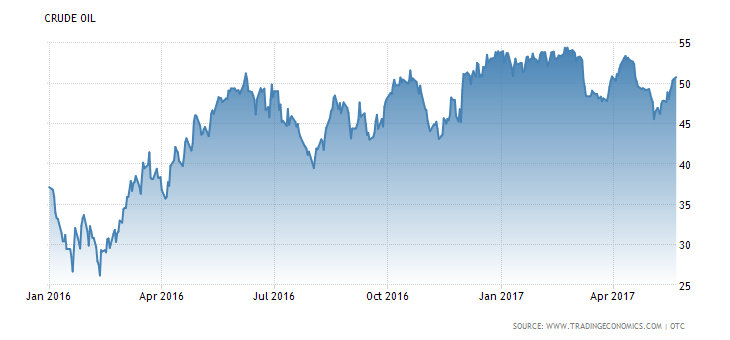
It’s been a fairly wild ride the last several years in the global energy markets. Oil prices crashed from over $100 per barrel to below $30 per barrel back in February of 2016, and have since stabilized in the $50 per barrel area today. See the chart below of WTI crude oil prices since the beginning of 2016:

What’s happened the last couple of years? Below is a quick summary of oil markets the last two years.

  • U.S. shale oil production increased dramatically over the last five years.
  • This, on top of increasing production in other global regions, led to an oversupply position in the global oil markets.
  • As the world produced more oil than it consumed on a daily basis, prices collapsed.
  • In reaction to precipitously falling prices, oil producers in the U.S. and globally curtailed production.
  • OPEC (led by Saudi Arabia) and non-OPEC (led by Russia) countries instituted oil production cuts.
  • Between curtailed U.S. production and the OPEC production cut the global supply/demand equation improved.

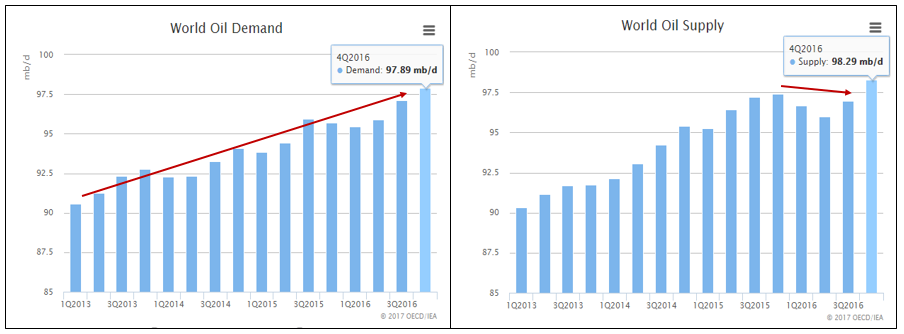
Looking at the charts below of global daily crude oil production and demand, we can see that things are fairly balanced right now after supply on the right-hand chart declined for several quarters:

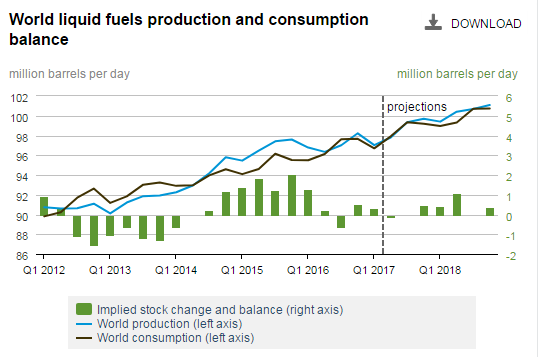
In fact, the U.S. Energy Information Administration (eia) forecasts that future oil market supply/demand conditions will remain balanced into 2018. See the chart below highlighting past and forecasted world production (blue line) and demand (brown line) by the (eia) below:

This balance should lead to more stable-to-rising oil prices going forward. Things to monitor going forward include:

  • the increasing level of U.S. production now that prices are stable (the U.S. is now a major swing producer in the global oil markets due to shale oil production)
  • the ability of OPEC and Russia to extend and honor their production cuts at the May 25th OPEC meeting
  • global economic growth and its effect on oil demand

Stable oil prices are generally a positive thing for the investment markets. We are forecasting WTI crude oil prices to finish close to $60 per barrel as we exit 2017. Oil prices at these levels will benefit:

  • the US economy in the form of energy sector jobs and capital investment
  • emerging market economies (many tend to be commodity based)
  • energy company earnings (about 15% of the stock market) which benefits the overall market
  • the high yield bond market and other energy related income producing securities

Overall, oil prices that are too low slow down our economy, just as prices that are too high can choke off economic growth. Prices in the $50 to $75 per barrel trading range will benefit the investment markets in our opinion. Prices in this range should benefit Gradient’s Energy Sector Focus portfolio as well as our more broad emerging market and energy sector holdings in the Gradient Tactical Rotation, Absolute Yield and Endowment portfolios.

To expand on these Market Reflections or to discuss any of our investment portfolios, please do not hesitate to reach out to us at 775-674-2222
Posted on May 24, 2017 Read More

News Archive