The U.S. Dollar is Up 25% – Who Benefits?

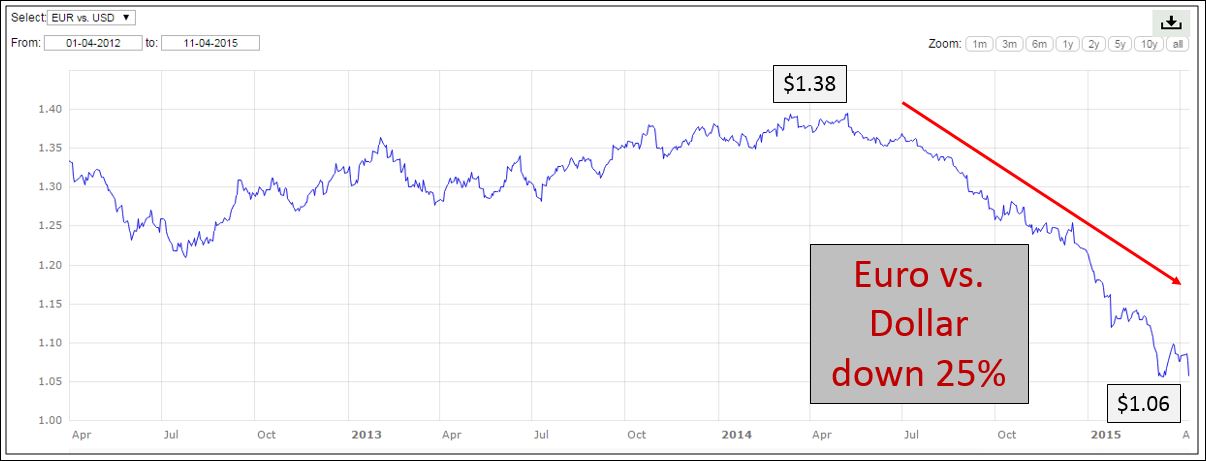
Over the last nine months, the US dollar has strengthened versus the Euro by 25% to levels not seen since 2003.

  • Last summer one Euro cost 1.36 U.S. dollars
  • Today one Euro costs only 1.06 U.S. dollars


This dramatic decrease in the value of the Euro versus the U.S. dollar is illustrated in the chart below. When the blue line is declining, the U.S. dollar is getting stronger.
Market Reflection Apr 15Source: European Central Bank

What is driving the strength in the dollar?

  • The U.S. economy has been solid, while Europe’s economy has been weak.
  • US interest rates are still higher than most European countries.
  • The US has terminated its quantitative easing (QE) programs, and Europe is just starting theirs.


Who are the winners in this situation?

  • The U.S. consumer is the big winner when the dollar is strong. All those products we buy that are manufactured overseas are now cheaper.
  • International travelers because a hotel room in Rome that was $200 per night last year is now $150.


Losers on the other hand are:

  • US companies which sell products overseas. Their prices seems higher over there, and foreign profits are now worth less.
  • Commodity prices because when the dollar strengthens, the prices of commodities generally drop (think oil, copper, steel, etc.)


We have been forecasting a flat US stock market this year. One of the reasons behind this is the expectation that the stronger dollar will slow earnings growth for many US multinational companies.

The Gradient 50 owns many blue-chip multinationals. As many of them generate a third or more of their sales internationally, near term estimates have been moderated due to the strong dollar.

  • International sales growth is curbed by higher prices for goods made in the US.
  • Foreign earnings will be translated back to US dollars.


Does this mean we should be selling our G50 stocks? No. With dividends currently providing a 3.5% yield, we continue to believe that the G50 is a good choice for income and growth investors. We expect them to continue to be rewarded over the long haul.

As of April 10, 2015:

Dow Jones US Moderately Conservative Index is up 2.86% (TR) for the year

S&P 500 closed at 2,102.06 up 2.10% for the year

U.S. 10 year Treasury Futures are yielding 1.95% down 0.22% for the year

WTI Crude Oil futures closed at $51.64 down $2.07 for the year

Gold closed at $1,204 per ounce up $21.70 for the year

To expand on these market reflections or discuss other portfolio strategies please don’t hesitate to reach out to the Gradient Investment team.

Posted on April 14, 2015 Read More

Gradient in The News – Time for investors…?

Posted on April 7, 2015 Read More

First Quarter Review – 2015

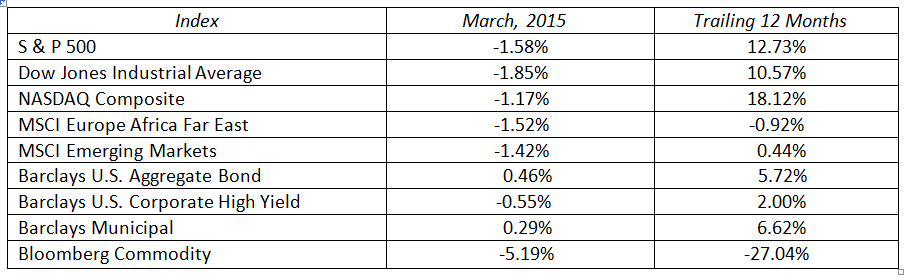
At the start of the New Year we warned 2015 would bring greater market volatility. The first quarter did not disappoint as the stock market continued the pattern of setting new highs, correcting, and then setting higher highs. The month by month results show the see-saw pattern in the U.S. market and the surprisingly more consistent performance of international stock markets.

April01_4

Our final four market moving news stories in the first quarter were: oil prices, the strength of the U.S. dollar, corporate earnings and the European Central Bank monetary easing program. The decline in oil prices has been a two edged sword. It has been a stimulant for the consumer; but painful for an energy industry moving from expansion to contraction. A twelve year high in the dollar versus the Euro has positive ramifications; but it has become a drag for U.S. companies exporting their products. Fourth quarter corporate earnings released in the first quarter has not been spectacular, although a majority of companies reported results better than expected. Winners like Apple were rewarded and the losers like Caterpillar were punished. Caterpillar was derailed by a combination of a weak demand, a strong dollar and disappointing earnings. In the first quarter the European Central Bank embarked on a U.S. style quantitative easing program. Six years after the original U.S. quantitative easing, it will be interesting to watch the European sequel.

This year’s first quarter results are very similar to a year ago, yet so is the macroeconomic environment. Interest rates are low by historical standards, the Fed monetary policy remains the same, the U.S. economy shows modest positive growth, the international markets are challenged, and geopolitical events continue to grab the headlines. From a valuation standpoint, forward price earnings ratios in the past year have expanded from 15 times to 17 times forward earnings. From here, price appreciation becomes more difficult. This market will require stronger earnings growth in the upcoming quarters to reach sustainable new highs. This is unlikely as earnings are being pressured by the strong dollar and lackluster economic growth. Low single digits returns from stocks this year would be a victory and mark the first time the U.S. stock market generated seven consecutive years of positive returns.

The bond market has entered a new era of extended low interest rates. Low interest rates will be the norm well into the foreseeable future. Demographics have created an insatiable appetite for fixed income investments as baby boomers try to protect principal and generate income for their living expenses. The bond market needs to come to grips with a Federal Reserve wanting to raise short-term interest rates in a weak economic environment. We expect marginally higher short-term rates later this year with stable longer term interest rates. Expect two to four percent returns from the bond market this year.

The remainder of the year will bring challenges and opportunities. The biggest challenge will come from within as investors need to manage their emotions in a volatile market. Commitment to your financial plan while keeping market driven emotions removed from the financial decision making process will be key. The long-term investor will be rewarded. Find your own distinct portfolio balance, embrace your financial plan and stay invested for the long haul.

MARKET BY NUMBERS:

April01_5

Posted on April 1, 2015 Read More

News Archive