The Tax Reform Bill

A federal tax reform bill was passed in the House of Representatives and a separate version was approved by the Senate. Now the two are undergoing a joint committee review and compromise with the hope of putting a final version to a full Congressional agreement by Christmas. The compromise is likely to get swift approval by the president.

This may seem to be a rushed process, but in fact tax reform has been debated in both chambers for several years. If the changes are indeed enacted, it will be the first major tax reform in 30 years.

For corporations:

A significant reduction in the corporate income tax rate has been proposed, from 35% to 20% by the House and Senate. Such a reduction has the potential to boost earnings for many companies in the S&P 500 by 6% on average according to Citibank* with some benefiting much more.

Further, both the House and the Senate plan to reduce the tax on cash repatriated from overseas which should benefit many of the companies in our G50 and G33 portfolios. Repatriated cash is expected to be used to invest for growth, buy back shares and increase dividends.

For non-service pass-through income companies (partnerships, S corporations and sole proprietorships) the tax reform bill is likely to contain a provision for a reduction in the tax rate.

The prospects for permitting companies to write off capital expenditures 100% in each of the next five years before gradually declining holds promise for a dramatic rise in machinery sales in the coming years along with higher after-tax profits for the machinery buyers.

For individuals:

Individual tax brackets are going to change. The top individual tax rate is reduced in the proposals, with the threshold for top rates nearly doubles for married filing jointly. See the current tax brackets with the proposed House and Senate tax brackets in the chart below.
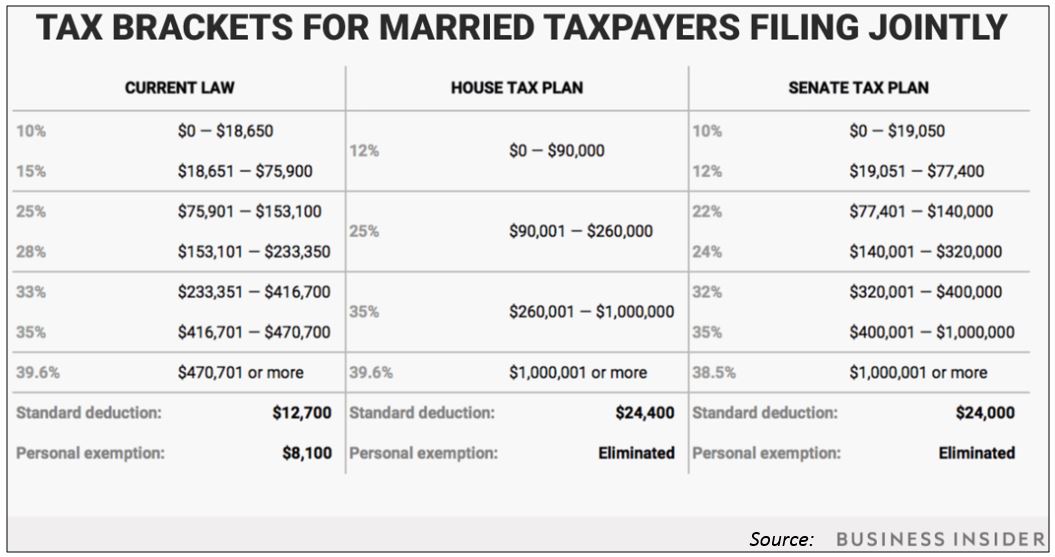
In the Senate bill the standard deduction will be doubled while the majority of itemized deductions will be eliminated. This alone will dramatically simplify tax filings. Child tax credits are also doubled as are the estate tax exemptions, to $22 million for married taxpayers.

Both the House and Senate bills would limit property tax deductions on a primary home to $10,000 and would eliminate state and local tax deductions on federal tax returns. A variety of other itemized deductions and exemptions are on the table for elimination.

The majority of middle-income taxpayers will experience an immediate tax cut, according to the Urban-Brookings Tax Policy Center, an independent analytical group. However, they estimate that 15% to 20% of those earning between $86,000 and $300,000 will experience an immediate tax increase.

The final bill on its own is expected to add to the deficit over the next ten years when the bill will expire (a mandated limit). However, that is expected to be offset by accelerated economic growth and thus added tax income anticipated under the plan.

In summary, the proposed tax bill should benefit the profitability of many of the US companies in which we invest as lower corporate taxes benefit earnings growth. Also, lower individual rates should benefit our consumer-driven economy.

To expand on these Market Reflections or to discuss any of our investment portfolios, please do not hesitate to reach out to us at 775-674-2222.
Source:
https://www.cnbc.com/2017/09/28/tax-cut-prospects-are-set-to-fire-up-earnings-growth-and-the-markets.html


Posted on December 12, 2017 Read More

And Down The Stretch We Come

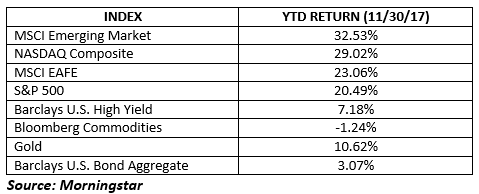
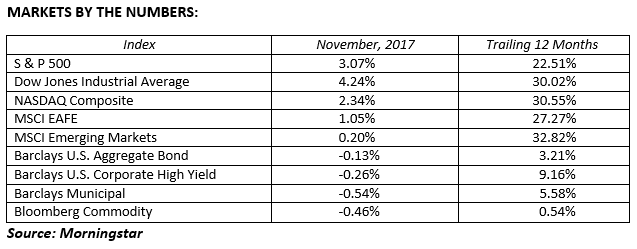
As the markets hit the final stretch run in full stride, there are only 20 trading days left to reach the 2017 finish line unscathed. It has been a remarkable year and another remarkable month for the financial markets. All asset classes are producing positive returns through November, and the stock markets refuse to pull back from this aggressive pace. Let’s take a quick look at the year to date performance on some key indices.

The Gradient Investment portfolios are also looking for a strong finish to the year. Our portfolios are managed to deliver a targeted risk level. So far in 2017, our higher risk portfolios are outperforming lower risk portfolios. This is not a surprise in a year rewarding risk takers. Remember, our advice is to never chase performance. It’s better to maintain a proper mix of portfolios, weighted to an appropriate risk level for each individual investor.

The Gradient Tactical Rotation and the G33 are our best year-to-date performers with returns running north of 20% through November. So far this year, growth companies have been well rewarded and value companies have trailed their growth counterparts. This fact has been well documented in our past communications. Our G50 and G40i portfolios are well positive through November, but lagging pure growth portfolios. Our fixed income expectations coming into this year were for low single digit returns. The Absolute Yield and Fixed Income Portfolios are on pace to deliver on this forecast.

December will be a key month in determining the setup for 2018. With third quarter corporate earnings season successfully in the books, market attention will turn to a handful of key policy and political factors. Let’s take a look at what is ahead for the markets;

Tax Reform – Does a tax reform bill come out of the senate and will it become law? Your educated guess is as good as mine, but I believe the stock market has priced in the expectation for lower corporate and personal tax rates. If this does not get passed, the stock market (especially small cap stocks) will be disappointed and ripe for an overdue correction. If passed, this should be good news for the U.S. economy helping both consumers and businesses. The stock market should smoothly sail into 2018 should Washington create a more competitive tax environment.

Government Shutdown – We have been down this road before, and experience tells us the stock market is not fond of government shutdowns. Today’s national politically charged environment does not make funding the government any easier. Complex issues ranging from immigration, repeal of Obamacare, funding the wall, and hurricane relief will provide every side with a reason to disagree. This may prove to be a tough hurdle to clear by the fast approaching deadline.

Federal Reserve – Jerome Powell has been nominated to be the next Chairman of the Federal Reserve replacing Janet Yellen when her term expires in early 2018. The partisan confirmation process will be in full force in December. Also the Fed has a December meeting where expectations are set for a 25 basis point fed funds rate hike. Higher short-term rates and yield curve flattening likely continue into 2018.

Geopolitical Risks – The market lives with these risks every day and has yet to be shaken by the events of 2017. Unfortunately, it only takes one event to send shock waves through the markets. Let’s hope the markets don’t have to deal with any irrational acts of violence.

If the markets can avoid these potential December pitfalls, we can get to January and make corporate revenues and earnings the focus again. A new earnings season and revised forecasts for fiscal year 2018 could once again give this bull market more room to run, as revenues are expected to grow at 5% and earnings to grow at 11%. Before we project 5-11% growth in the stock market next year, let’s see how the financial world handles these critical December events.

To expand on these Market Commentaries or to discuss any of our investment portfolios, please do not hesitate to reach out to us at 775-674-2222

Posted on December 4, 2017 Read More

What Are The Bond Markets Telling Us About The Stock Markets

We’ve long talked about the high correlation between stock prices and market fundamentals. The fundamentals are highlighted below:

  • The health of the economy: it’s been growing at a moderate and stable pace
  • Corporate earnings growth: they’re forecasted to grow 10% this year and in 2018
  • Company and market valuations: they’re on the rich side, but not extreme

One metric that tends to go unnoticed is how the stock market also benefits from low interest rates. Lower interest rates generally make stocks look more attractive. The thesis is that if investors can’t earn a reasonable return in the fixed income markets they’ll look toward stocks to earn a higher, albeit more volatile return. Many Wall Street strategists are currently looking at the bond market as another avenue to judge the direction of the market. Two items that could give them concern are:

  • A rising 10-Year Treasury yield
  • An inverted yield curve (10-Year rates lower than 2-Year rates)

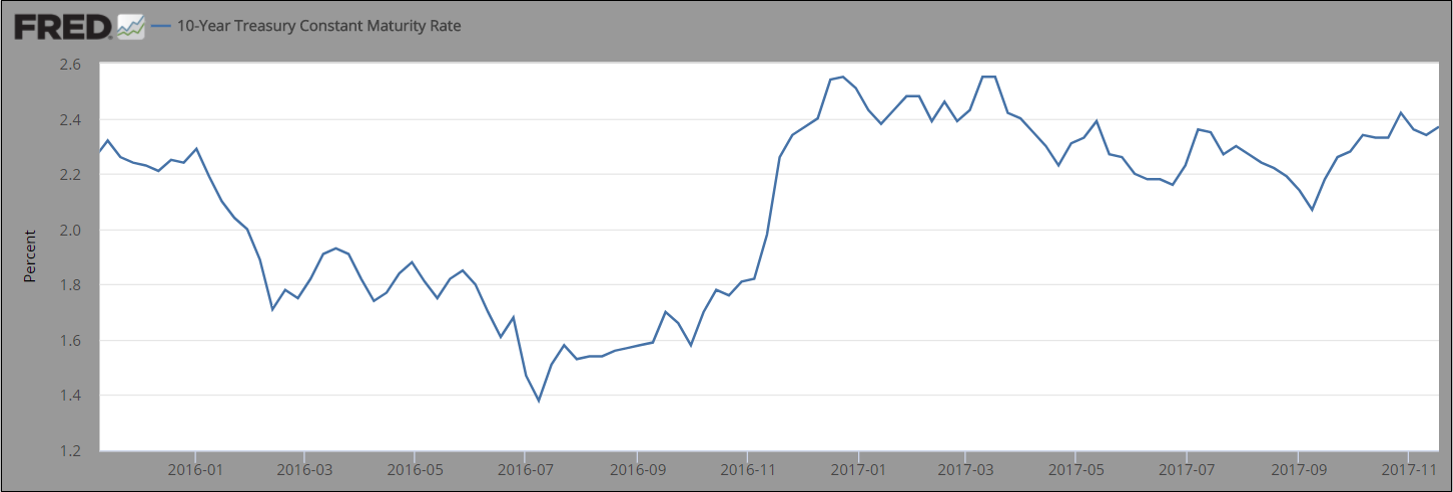
Interest rates have been low for a long time, and continue to be low. The Federal Reserve Bank (the Fed) has raised the “Fed Funds Rate” four times since December of 2015, after leaving it at zero for seven years. The 10-Year Treasury yield bottomed at 1.37% in July of 2016 and trades at 2.33% today. Longer term the 10-Year has averaged around 4.00%. If the 10-Year yield continues to rise between 3% and 4% levels, the returns of stocks and bonds will become more equalized and investors could be incented to rotate from stocks to bonds. The 10-Year Treasury yield is graphed below:

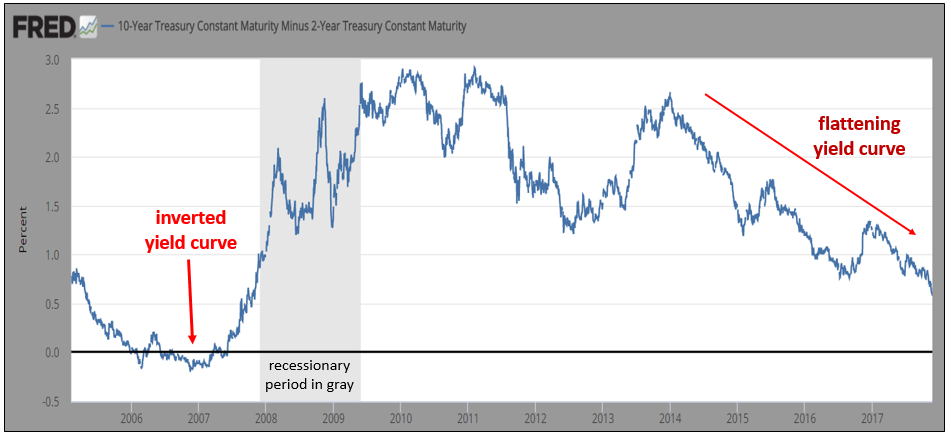
Another bond market chart that many strategists are watching is the spread between the 2-Year Treasury and the 10-Year Treasury. When the spread is positive we have a “normalized yield curve”. When the spread is negative we have an “inverted yield curve”. Recently the bond market’s yield curve is becoming flatter. This means longer term (10-Year) interest rates are slipping towards shorter term (2-Year) rates. The concern here is that a flat, or even an inverted, yield curve in the past has signaled a recession. The chart below highlights the spread between 10-Year and 2-Year yields; it’s still positive but becoming much flatter:

The US yield curve is now at its flattest point in roughly ten years. The gap between 2-year and 10-year yields has shrunk to just 0.58 percentage points, the lowest since 2007. In the past an inverted yield curve has been an indicator of an upcoming economic recession. We’re not inverted yet, but investors are closely watching this indicator as the gap shrinks.

Interest rates that are too high, or a yield curve that is too flat can cause concern amongst investors. We don’t believe 10-year interest rates are too high yet at 2.33%, but the flatter yield curve is something to watch as lower longer term interest rates tend to signal investor expectations for weaker economic growth and lower investment returns in the future. We are not there yet, but an inverted yield curve would certainly be a yellow flag for the investment markets and we’re watching this metric closely.

To expand on these Market Reflections or to discuss any of our investment portfolios, please do not hesitate to reach out to us at 775-674-2222.
Posted on November 28, 2017 Read More