Post-Election Stock Market Update

The market has been on an impressive run recently. To review, as we neared the election, the S&P 500 had slid roughly 5% from recent highs and closed at 2,083 on November 4th. Since that time, the S&P 500 has returned 14.8% to close at 2,378 on Friday, March 17th. In today’s Market Reflection, we are going to analyze what has worked, and what hasn’t worked, during this period.

Sectors:
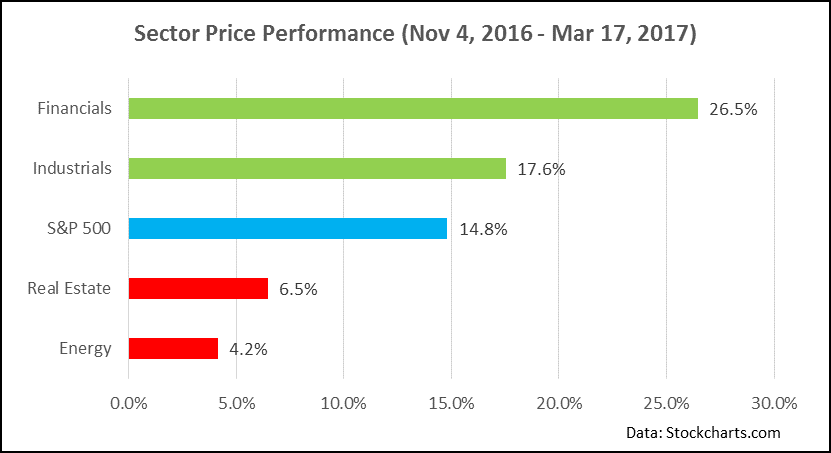
During this recent market rally, there has been a wide divergence of sector performance within the S&P 500. Financials and Industrials sectors have been leaders while Energy and Real Estate have lagged (see below chart). Financials performance has been tied to two factors: rising interest rates which tend to benefit banking and insurance companies, and sentiment that regulatory costs may be less of a burden with the newly elected administration. Industrials performance has been a result of improving fundamental and economic data combined with positive sentiment regarding potential enhanced infrastructure spending to accelerate GDP growth.

Sectors that have lagged the market include Energy and Real Estate. Energy performance has been hampered by a retracement of oil back below $50 amidst discussions of increased supply returning to the market. Real Estate underperformance can be explained by valuation in a rising rate environment. In a low yield environment, where investors are seeking income, Real Estate Investment Trusts (REITs) tend to receive a premium valuation due to their relatively high dividend payments. When interest rates begin to rise, REIT valuations tend to drop as investors transition to lower risk assets to generate their needed income.
Style:
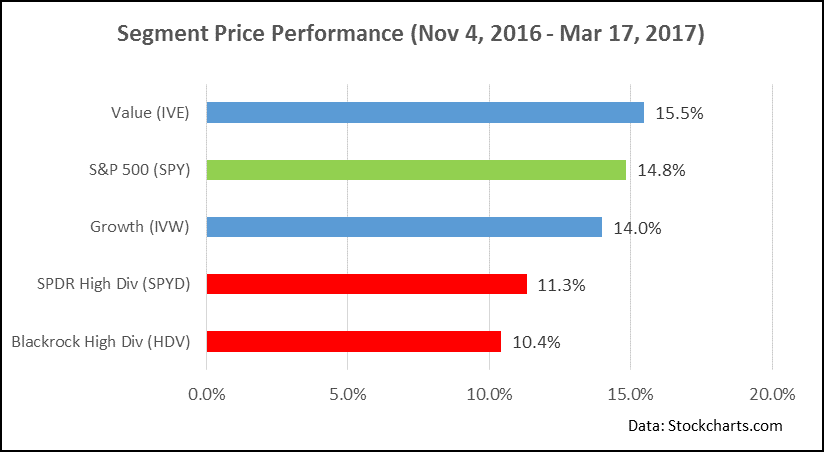
The below chart reflects S&P 500 performance by style. As you can see, there hasn’t been a dramatic divergence of performance within the classic style segments of value and growth. Where we have seen a large style differential is the underperformance of high dividend paying stocks. According to the chart below, two large cap, high dividend ETFs (HDV and SPYD) have underperformed the overall market since the election. The issue for high dividend stocks is similar to the situation for REITs described above. As investors generate more income from bonds (through higher interest rates), there is less willingness to pay a premium for dividends generated through the stock market. This transition typically affects Real Estate, Telecommunications, Consumer Staples and Utility sectors the most. Most high dividend portfolios tend to have greater concentrations in these sectors compared to the overall market. Therefore, in a rising rate environment and an expectation of accelerated growth, it is fairly common for dividend focused portfolios to underperform the general market.
In conclusion, though we have seen very strong performance post-election, it is important to realize that this is a very short period of time for which to make broad conclusions. Sectors and styles are continually adjusting in and out of favor, and it takes a disciplined investment process to stay focused and avoid “chasing” short term trends that may erode long term performance.

At Nevada Retirement Planners, we design portfolios with long term objectives in mind using strategies that have been proven over several investment cycles. Each portfolio is designed with a core philosophy that is designed to meet a variety of client needs like principal preservation, income generation, or growth. Lastly, we use multi-portfolio solutions to generate diversified sources of return that meet client needs and are consistent with their risk tolerance and time horizon. If you would like to learn more, please give us at call at 775-674-2222.
Posted on March 21, 2017 Read More

Exchange Traded Funds (ETFs) Explained

Investors are familiar with the traditional stock and bond and alternative asset classes, typically choosing to buy individual securities. But what are exchange traded funds, and how do they provide exposure to these three asset classes? Why are they growing quickly, and how should they be utilized?

Exchange traded funds are low cost, pooled investment vehicles to enable diversified investment in a variety of stocks or bonds or alternatives. Most ETFs simply track an index, i.e., the S&P 500, the Barclays Aggregate bond index, the NASDAQ 100, gold, etc. to enable asset allocation among the major asset classes. ETFs are highly liquid; each can be bought and sold throughout a regular trading day.

From the original ETF created in the early 1990’s, there are now over 2,000 ETFs with combined assets of $2.8 trillion.* In fact, the dollars invested in ETFs has doubled over the last four years** and U.S. based ETF assets have grown by 30 percent while mutual funds grew just 3.5 percent in the last year.***

Why were ETFs created, and why are investors choosing to utilize them so widely? It was primarily growing dissatisfaction with high fees in the traditional mutual fund market that has driven more investors, individual and professional alike, to consider adding ETFs to their portfolios. Unlike mutual funds, ETFs have no upfront load charges, and their annual fees tend to be lower than many mutual funds.

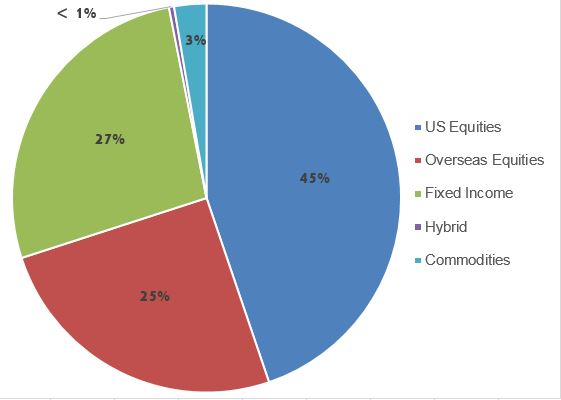
In terms of new money added, the following chart indicates how ETF fund flows were invested during 2016:

Source: Investment Company Institute

ETFs can be used not only to replicate an index, but can also be used in actively managing portfolios depending on the investor’s preference for a particular slice of the market at any point in time.

Investors can choose a stock sector fund, i.e., materials, which will go out and purchase a pool of stocks in the materials sectors. The diversification allows for materials sector-type returns without single security volatility and risk. There’s an ETF for the stock markets of most countries around the world, and there are those which represent a region, i.e., Latin America.

Within fixed income, investors could choose Treasury inflation-protected bonds, emerging market bonds or a slice of less-than-investment-grade U.S. bonds via an ETF which could reduce risk within an otherwise volatile sector of the bond market (again without incurring single security risk).

The essential thing to remember about trading in ETFs is that it is imperative to understand what positions are held in each ETF in order to meet investing goals. While most ETFs incorporate over a dozen holdings, some include nearly 1,000. An ETF could contain a single security which accounts for a very significant portion. Some are routinely rebalanced to match a formula, i.e. the lowest volatility stocks in the S&P over the last 12 months, so reviewing those holdings from time to time is important.

With the proliferation of ETFs, there are more selections available for use within portfolios. At Nevada Retirement Planners, we believe ETFs offer an opportunity to cost effectively manage investments to meet our clients’ needs for protection of principal, income or growth across our Laddered Income, Absolute Yield, Endowment Series, Precious Metals and other strategies on an active basis.

Please contact us at 775-674-2222 to discuss how exchange traded funds may be applicable to your long term financial goals and objectives.

Sources: * XTF Research
** Barron’s 3/11/17
*** Investment Company Institute 2/27/17


Posted on March 14, 2017 Read More

Embrace The Moment

It is important to have and maintain the proper perspective and attitude in your financial journey. The lenses through which we view the world shapes both our market and political views. When your eyes become older, or shall we say more experienced, you realize two lenses may be required to see clearly. Bifocals perform a great service for those of us seeking clarity. As investors, we should use one set of lenses to assess the political landscape, and another set to analyze the markets. Separating your political views from your market assessment will provide a much sharper market focus. A key role of Nevada Retirement Planners is to help you navigate through all the noise and distraction, while getting your portfolio keenly focused on your financial goals.

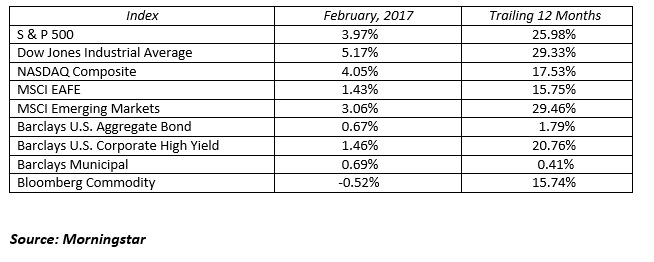
Let’s focus on the markets. In February, the bull market in U.S. stocks continued its run to levels never before seen. Dow 20,000, once an unreachable peak is now 812 points in the rear view mirror and Dow 21,000 is knocking on the door. It was a remarkable month for stocks with only five down days and twelve consecutive record breaking closes for the Dow. Market leadership came from the consumer goods, healthcare, and financial sectors. Apple was the one thousand pound gorilla in the room, gaining an amazing 12.8% in the short month. Healthcare was led by Pfizer and Johnson and Johnson with returns just below 10%. Banks had a solid month across the board as the prospects of higher interest rates would improve net interest margins and the proposed peel back in regulation provided additional fuel for their rally. Basic materials took a breather led by declines in some of the major oil companies like Exxon which was down just over 4%. The U.S. stock market as measured by the S&P 500 gained 3.97% in February, outpacing the emerging markets and international markets which returned 3.06% and 1.43% respectively.

Interest rates, which have gone absolutely nowhere this year, should begin to drift higher as the economy continues to grow and Washington discovers fiscal policy once again. Fiscal policy is important to the Federal Reserve because it provides them more latitude to implement a more restrictive monetary policy. Chairwomen Janet Yellen made clear in testimony to Congress that rate hikes are “on the table” for their March meeting and I imagine each Fed meeting this year. The Fed needs to return to a normalized monetary policy before they can begin addressing their bloated $4.5 trillion balance sheet. The Fed has a long way to go and raising the Fed Funds rate is just the beginning.

Higher interest rates mean lower bond prices. Time also plays an important role in bond price action. We believe the rate rise this year will be gradual. This means the income earned from bonds over the course of the year will have the opportunity to cushion the price decline. This path is less painful than an immediate rise in interest rates which causes a sudden price decline. In this scenario, investors need twelve months of income to repair the effects of a sudden rate increase. It’s okay to own bonds for the basic reasons of income, principal preservation or volatility control, but temper your expectations from this asset class. Earning the coupon alone would make for a great year in bonds.

Whether your t-shirt reads, “Make America Great Again” or “Dump Trump”, please check it at the door and embrace the financial markets on their own merits. As explained in last month’s commentary, we are positive on the global stock markets in 2017 and cautious on the outlook for bonds. The path will not be a straight line higher, rather periods of strength followed by consolidations as news and revised expectations are priced into the markets. If watching cable news is now a hobby, either embrace the perceived chaos you hear every night or change channels if your market view is being swayed. Nothing trumps a solid financial plan. Stay on your path.

MARKETS BY THE NUMBERS:

To expand on these Market Commentaries or to discuss any of our investment portfolios, please do not hesitate to reach out to us at 775-674-2222

Posted on March 1, 2017 Read More

News Archive