The Case for Dividend Stock Investing

Within Nevada Retirement Planners, we have two stock based strategies, the Gradient 50 (G50) and the recently introduced Gradient 40 International (G40i), that emphasize dividend income as part of their value proposition. In today’s market reflection, we are going to provide you with our thoughts as to why dividend based investing provides long-term portfolio value.

Reason #1: Dividends generate income in a low yield environment
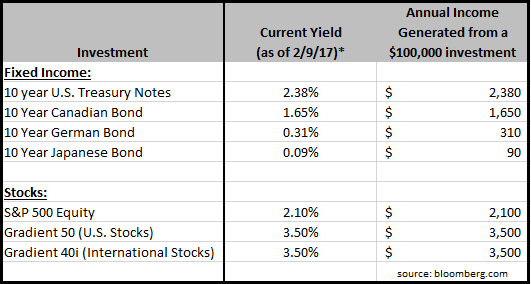
The current yield on a 10-year U.S. treasury note is 2.38%. This is near a 30 year low. In other countries, 10-year yields are even lower. The data shown below illustrates the current yield and annual income generated from a $100,000 investment in each particular country’s debt. The data also reflect the current dividend yield and annual income generated from a $100,000 investment in the S&P 500, the Gradient 50 (U.S. stocks) and Gradient 40i (international stocks) portfolios. In this low yield environment, an allocation to select stocks that pay consistent dividends can generate additional income to supplement the payments received from fixed income investments.
100k-sourced

Reason #2: Dividends have the ability to outpace inflation
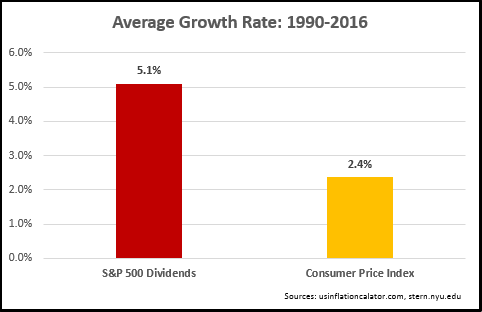
With fixed income coupon payments, the amount of payment generally stays the same through maturity. Over time, prices of goods and services tend to rise (inflation), and the result of rising prices means the fixed coupon payments become less valuable – investors lose purchasing power. Dividends from stocks have the ability to outpace inflation as many companies can, and do, raise their dividends over time. As the chart below shows, the average dividend growth rate of stocks (represented by the S&P 500) has outpaced average inflation (represented by the Consumer Price Index) since 1990.
cpi-sourced

Reason #3: Dividends can provide defense in turbulent markets
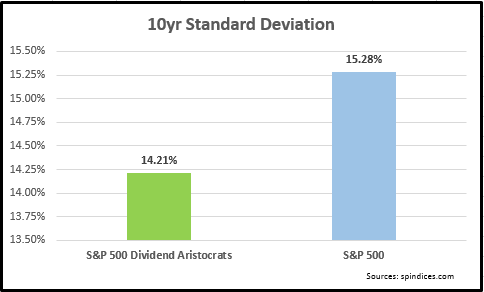
The majority of dividend paying companies tend to be large, relatively stable companies within defensive industries like Consumer Staples, Telecommunications, and Utilities. Over an extended period, these companies tend to exhibit less volatility compared to the broad market. This can be shown by looking at comparable standard deviation over time. Standard deviation tends to be the preferred method to measure market risk, where higher standard deviation represents higher risk. The below chart reflects the standard deviation of a dividend paying portfolio (the S&P Aristocrats Index) versus the broad market (S&P 500). Over the last 10 years, the data shows that the S&P 500 Dividend Aristocrats have had consistently less average risk compared to the broad market.
dividend-sourced

Reason #4: Dividend paying companies provide income and price appreciation potential
When an investor purchases a bond, the expectation is to receive coupon payments during the time of holding and receive a return of principal at maturity. When an investor purchases a dividend paying stock, there is an opportunity to benefit from price appreciation of the underlying during the holding period. Investing in stocks does involve increased risk, but over extended periods the stock market tends to appreciate. As a result, investors can be rewarded with both dividend income and a return on their initial principal investment.

Risks to dividend stock investing
While we at Nevada Retirement Plannners believe in the long-term benefits of dividend stock investing, we would be remiss not to point out some of the risks. Unlike fixed income coupon payments, dividends are voluntary payments from companies and can be reduced or eliminated in times of stress. Second, with fixed income instruments, there is an implied return of principal at maturity unless the entity is subject to default. When investing in stocks, the principal amount may increase or decrease, and invested assets typically display higher volatility (or increased risk) compared to fixed income investments. These risks should be factored into the overall asset allocation strategy that is based on an individual’s return needs, risk tolerance, and investable time horizon.

In summary, an allocation to dividend paying stocks is a proven investment strategy that can provide growth and income for investors over time. An allocation to dividend paying stocks, both U.S. and international, can provide supplementary income to meet investor needs as well as the opportunity to grow assets over time. While not without risk, we believe dividends are a valuable source of portfolio returns, and we continue to recommend dividend paying stocks as part of our investment allocation strategy.

To expand on these Market Reflections or to discuss any of our investment portfolios, please do not hesitate to reach out to us at 775-674-2222
Posted on February 14, 2017 Read More

The Road Ahead

January brings a New Year with new political leadership and a new set of economic and political uncertainties. This is both normal and healthy. Learn to embrace change and volatility as it often creates long-term investment opportunities. Since we do not have a crystal ball, we evaluate the road ahead by actively monitoring key fundamental factors. Let’s walk the road as we see it unfolding this year.

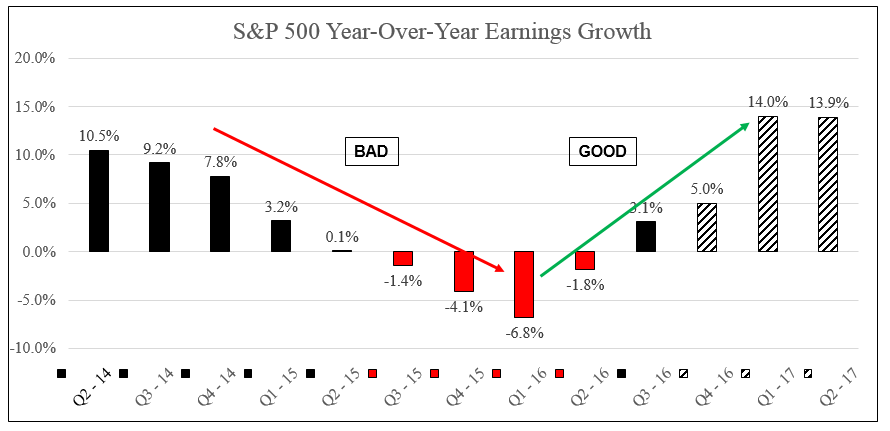
Yes, the stock market continues to trade near all-time highs and a temporary early year price consolidation would not be a surprise. Equally possible is the scenario where the train continues to pull away from the station as new pro-growth policies and potentially lower corporate taxes benefit stock prices. The fundamental facts as we see them show stable to expanding core economic growth through 2018. Future growth in the 2-3% range will push the stock market higher. At the heart of the fundamental story is an acceleration of corporate earnings. The stock market navigated the deceleration of earnings growth and now we enter a more positive earnings phase. Remember, its earnings and valuation that drive stock prices. Positive earnings will be a positive force.

ee

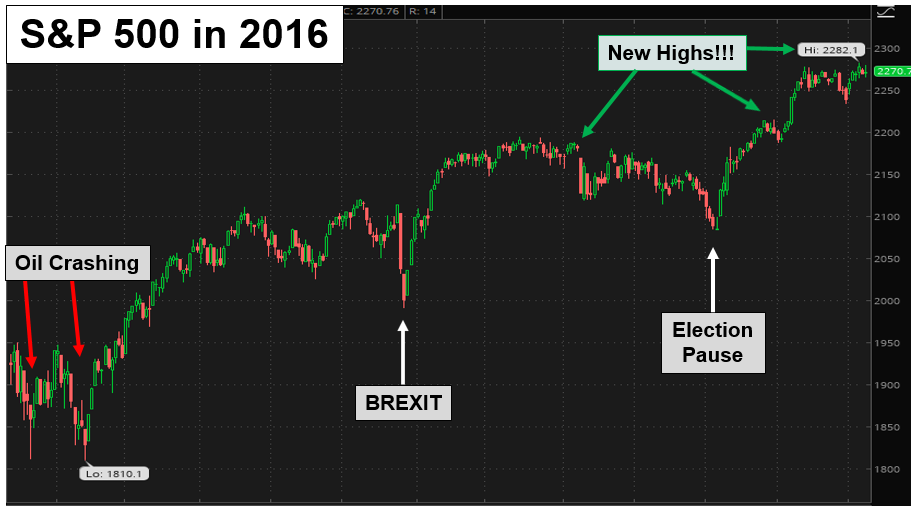
We see the U.S. stock market generating positive returns in the 5-10% range for the calendar year. Experience tells us the path to high single digit returns is not a gentle sloping line, rather a series of rallies and subsequent pullbacks. This year may in fact look like last year’s price action with new reasons for periods of price consolidations. Below is the 2016 path traveled.

stocks2916

If stocks are up 5-10%, what happens to bonds? The bond market is entering a new phase as the Federal Reserve’s seven year zero interest rate policy is coming to a close. Interest rates will begin an orderly move higher lead by the short end of the yield curve. The Federal Reserve now has room to begin the process of normalizing monetary policy. While the Fed has threatened for two years to embark on a systematic plan to hike the fed funds rate, we believe this is the year where it really begins. Three or four quarter point rate hikes will leave the fed funds rate near 1.50% by the end of the year.

The journey to higher interest rates will cause bond prices to decline and returns to be skimpy in 2017. Flat is our call, but plus or minus a few percentage points can easily occur. Investors should still own bonds for reasons of principal preservation, income generation or for overall portfolio volatility control, but realize this is not an asset class to make you rich this year. After higher interest rates are achieved, bonds will offer a more compelling future value. Bottom line in 2017 is, “don’t expect much offense from your bond portfolio”.

Every time period deals with market volatility and uncertainty. The markets have survived two World Wars, the great depression, stagflation, an oil crisis, the internet bubble and a financial crisis. This time is no different as the weight of the world can cause rational investors to second guess their investment decisions. This a dangerous trap to fall into, so be strong and avoid the temptation to eliminate risk. Risk makes you wealthy. Traveling through your investment horizon with confidence, conviction and patience is hard work, but the rewards are great. Five years from now, it will not matter if the market is up or down 5% in the next few months. Stay long and strong for the long haul.

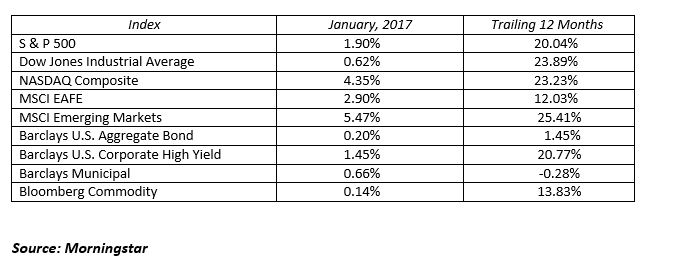
MARKETS BY THE NUMBERS:

jan2017

To expand on these Market Commentaries or to discuss any of our investment portfolios, please do not hesitate to reach out to us at 775-674-2222
Posted on February 7, 2017 Read More

Precious Metals – For Your Consideration

Precious Metals were among the best performing asset classes in 2016 following three years of underperformance. Why would we be interested in precious metals at this juncture? Over long periods of time different assets perform differently under varying market and economic conditions.

Each of the four primary precious metals — gold, silver, platinum and palladium — has its own key drivers of supply and demand. No one metal continuously leads the others and each can be volatile alone, so a basket of all four precious metals is preferred to owning just one. In this analysis, we will address our outlook for the price of each.

Gold is the most widely traded of the precious metals and is considered a store of value in periods of weakening local currencies, rising inflation, increased market volatility and black swan events (i.e., BREXIT, perhaps spring ’17 elections in France, fall ’17 elections in Germany). Rising interest rates will work against the price of gold IF they are increasing in real terms, that is, after taking into account the rate of inflation.

Alternatively, the rising U.S. dollar versus other currencies following Trump’s election pressured the price of gold in the final weeks of 2016. The thinking was that rising tariffs and other protectionist moves under our new president would erode overseas growth going forward. In an increasingly interconnected global economy, we believe this is less likely than the rhetoric to date would indicate. In fact, gold has been one of the best performing assets at the start of 2017, up by 5 percent, on top of a 9 percent gain for all of last year.

On the supply side, gold mine production is expected to rise very slightly this year to peak levels* before dropping in the coming years as miners continue to cut investments. We believe investor demand will rise in a year of:

  • low real interest rates
  • increasing inflation for inputs and wages
  • rising political uncertainty around the world

Tempering the demand for gold will likely be continuing pressure in a major key market, India, where there has been a focus on currency corruption. Taken together, we believe the price of gold still has the potential for 5-10% gains over the remainder of 2017.

Silver production is expected to drop 1 percent this year after ten years of increases.* We expect production will continue to drop in the coming years based on cuts in mining operations. From the demand side, we believe global economic recovery (infrastructure and industrial activity plus rising costs of inputs) will be favorable for holders of silver. Following a 12 percent gain in 2016, silver could rise double-digits again this year in our opinion.

Platinum supply is expected to decline 3 percent this year* following a similar decline last year when prices for platinum were up just 1 percent. Demand meanwhile is expected to be flat or up slightly in 2017 based on global economic recovery including rising European and Chinese auto production.

Palladium supply deficits have occurred in each of the past four years, and are expected to persist for the next few years.**** Here we are forecasting continued increases in demand given our outlook for rising U.S. infrastructure spending, accelerating global auto sales and global economic growth. On top of a 21 percent gain last year, we expect palladium prices to rise again in 2017.

Nevada Retirement Planners offers an actively managed Precious Metals strategy to complement stock and bond allocations for many investors. We also include precious metals in our ETF Endowment Series. Please contact us to discuss how precious metals may be applicable to your long term financial goals and objectives.

Sources:
* Metals Focus Ltd.
** Metals Focus Ltd.
*** Metals Focus Ltd.
**** Johnson Matthey, November 2016

To expand on these Market Reflections or to discuss any of our investment portfolios, please do not hesitate to reach out to us at 775-674-2222

Posted on January 24, 2017 Read More

News Archive