Year In Review

The year was a tale of two markets. The first six weeks belonged to the bears, and the last six weeks the bulls were in charge. The bulls had the final say once again.

The year got off to a rough start as major stock indices were down double digits, reaching their eventual low water mark for the year. The Dow Jones Industrial Average bottomed at 15,450, the S&P 500 hit 1,810, the yield on the 10-year U.S. Treasury was 1.63% and oil was $26.19 per barrel. Fast forward to the post-election euphoria and we almost saw Dow 20,000, the S&P 500 hit 2,270, the 10-year U.S. Treasury yield north of 2.50% and the price of a barrel of WTI crude settled in the $50 area. What a difference 10 short months can make.

The election provided a new coach with a new playbook. The market obviously likes what it is hearing, but the new team has not taken the field yet. The new playbook has plans to be pro-business with lower taxes, less regulations, reformed health care, energy independence and a keen focus on growth and jobs. The plan on paper looks great, but it still needs to be executed on the field with opponents fighting hard at every turn. The market has given us a glimpse of what could be, but keep in mind the market will eventually trade on what will be.

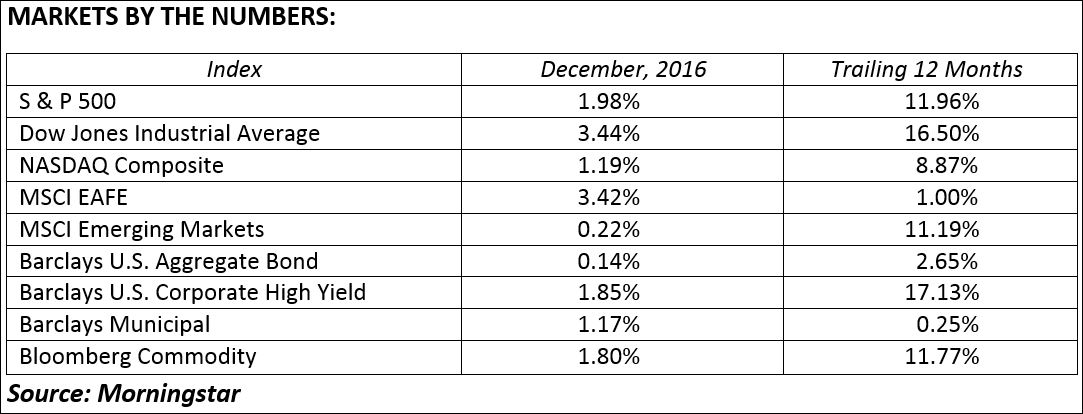
After a gut wrenching start, stocks turned the corner and produced solid returns this year. The Dow Jones Industrial Average gained 16.50% for the year, the S&P 500 was up 11.96%, and Emerging Markets delivered 11.19%, while MSCI EAFE added just 1.00%. The big stories for stocks this year was the turnaround in oil prices, low interest rates and the beginning of an earnings recovery. The prospect of a new pro-growth political environment added to the bullish momentum.

Bonds generally moved in opposite directions from stocks this year. Bonds rallied early in the year as oil prices collapsed and it became apparent the Federal Reserve was not going to raise interest rates at the pace they themselves had projected. The post-election stock rally negatively impacted bond prices as the Federal Reserve is now in play and increased economic growth may pave the way to higher rates.

If the economy begins to grow faster, expect interest rates to move higher in an orderly fashion. For the past two years the Fed told us they expected to raise the Fed Funds rate four times at 25 basis points in each year. Their eight forecasted rate hikes became one 25 basis move in 2015 and one in 2016. This will likely be the year when we finally get the four 25 basis point hikes. This is not all bad news, just reflective of a stronger economy where the Fed finally has room to maneuver.

Bond investors will need to prepare their portfolios and their expectations for a new world of gradually higher interest rates. Defense in bonds will be the name of the game. Short duration, floating rate notes, TIPS and asset-backed securities should provide the best opportunities in 2017. Own bonds to diversify your overall portfolio. Positive low-single digit returns would be the best outcome next year, and slightly negative returns would not be a surprise.

The New Year may see some consolidation from the post-election rally. If it comes, don’t be tricked into thinking it is the beginning of the end. Economic optimism and higher corporate profits fuel rallies. Our forecast is for 5-10% upside in equities next year with bonds struggling to produce positive returns. Stay positive, stay invested.
year-end-commentary

To expand on these Market Commentaries or to discuss any of our investment portfolios, please do not hesitate to reach out to us at 775-674-2222
Posted on January 10, 2017 Read More

Investors Finally Rotating Out Of Bonds

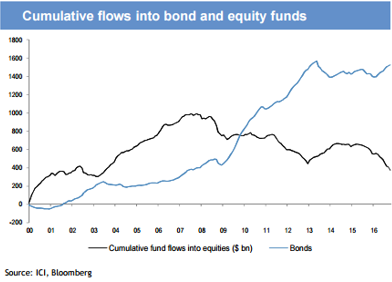
In the month of November, we have seen a reversal of the long term trend of flows into bond investments. The chart below reflects cumulative flows of assets into equities/stocks (black line) versus flows into bonds (blue line). As the data shows, since the severe downturn of the equity markets in 2008, fund flows into bonds have been significantly higher than flows into equities.

mkt-reflection-chart-1

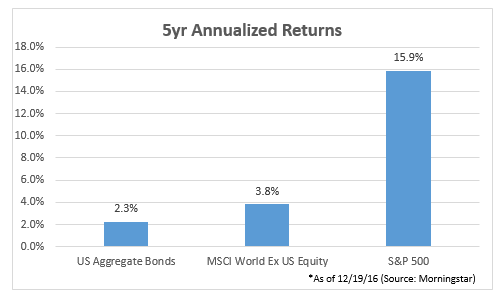
This is despite performance that has generally been favorable to equity versus bonds. During the last five years, US equity performance (based on the S&P 500) has had a 15.9 percent annual return compared to International equities at 3.8 percent and US bond performance at 2.3 percent. Clearly, investors have remained cautious of equity markets post the financial crisis, and have preferred the relative stability of bonds despite the lower return rates.

mkt-reflection-chart-2

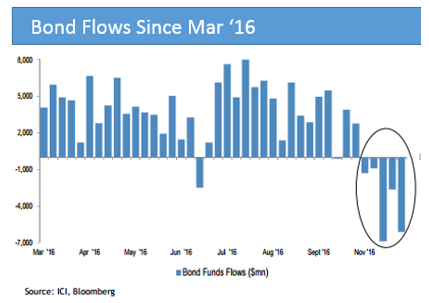
As the chart below reflects, this trend has shown some recent signs of change. According to data from EPFR Global, bond outflows for the week ending Nov 16th, 2016 were the largest in over three years. The outflow trend has continued in recent weeks as rising rates have had a negative effect on price performance for bond funds and ETFs.

If interest rates continue to rise, as we anticipate, prices on existing fixed income/bond investments tend to fall. If investors see prolonged declines of fixed income prices, it is likely to accelerate the trend out of fixed income and into equity. This would have a positive effect on equity markets as increased demand should increase the price of stocks.

mkt-reflection-chart-3

Historically, fixed income/bond investments have been less volatile than the stock markets. That doesn’t mean, however, that bonds cannot lose value during certain periods. As we look to 2017, we anticipate a rising interest rate environment, and bond investors should expect low total returns with a possibility for slightly negative returns. Despite the lower expected returns, we continue to believe that bonds should remain as part of a strategic portfolio allocation due to their diversification benefits and lower volatility.

To expand on these Market Reflections or to discuss any of our investment portfolios, please do not hesitate to reach out to us at 775-674-2222
Posted on December 21, 2016 Read More

Follow the Fundamentals

The election is over and democracy lives. It was fascinating to monitor the stock and bond markets in the days just before and after the election. In the two days leading up to the election, the pollsters and media had everyone convinced the outcome was known. The markets were comfortably braced for more of the same. The stock market rallied strong on Monday and again on Election Day. In the twenty fourth hour on Election Day, it became apparent voters had a different plan as Donald Trump was on the verge of becoming President-elect Trump. Immediately headlines began streaming: Dow futures down 300, Dow futures down 500, Dow futures down 800, five percent limit down on the S&P 500 futures. My final thought of the evening was, “Tomorrow will be a great buying opportunity.”

When the next day arrived, so did some rational thinking. In the pre-market, futures were down just 1.5 percent versus the five percent limit down from the previous night. By the time U.S. stocks opened for business, they quickly rallied back to flat and proceeded to close up 1.5 percent on the day. When the week ended it was the best week for stocks in the past five years. The three major stock market indices went on to post three new highs for the year.

On November 29 the OPEC members agreed to a 1.2 million barrel per day oil production cut in a resolve to boost prices. Although it was a widely anticipated event, doubts of a significant agreement had been gathering in the days and weeks leading up to the meeting. Oil prices rose 9.5 percent on the announcement to nearly $50 per barrel, and the energy sector as a whole rose significantly.

There are a few key points to take away from these experiences. Remember that it’s “time in the market” versus “timing the market” which makes all the difference. You should always be invested (at the right risk level) and especially during strong markets that are sometimes unexpected. We are true believers that your political views should not influence your investment plan; this rang true in November. Politics are personal and based on your beliefs and values, while your investments need to be rooted in market fundamentals.

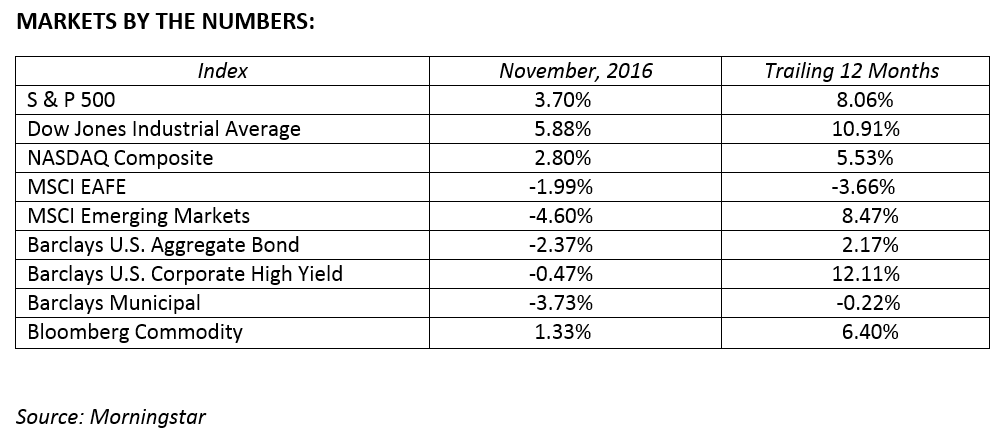
The S&P 500 had a very strong month, up 3.70 percent to close at 2198.81. Likewise, the Dow Jones Industrial Average and the Russel 2000 reached new records in November. The stock market was led by financials and energy. International stocks did not fare as well as future U.S. trade policies are a bit uncertain. Emerging markets posted a 4.60 percent drop while developed international stocks declined 1.99 percent in November. Corporate earnings season is in full swing and the results have shown a much-awaited turnaround, albeit small. Earnings are beginning to grow again!

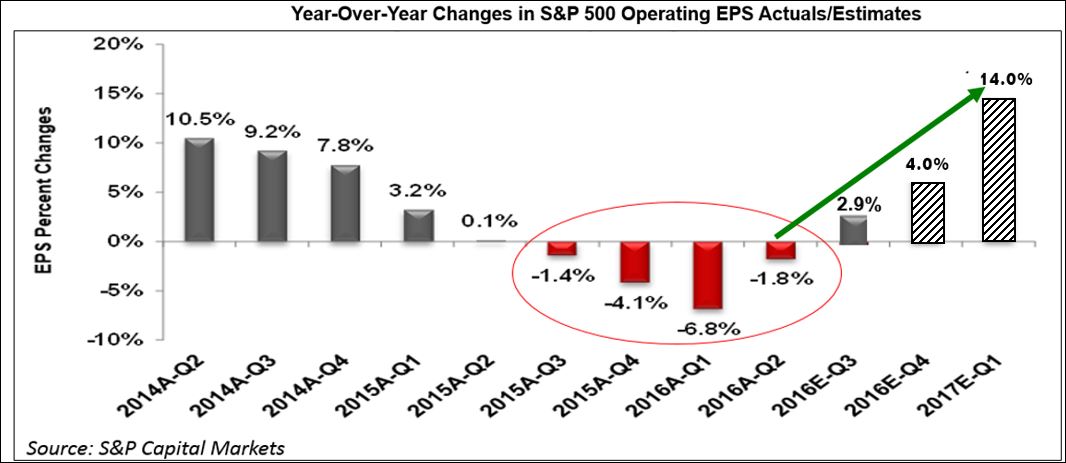
In December we will focus on analyzing what went well this year and what we can look to enhance as we enter 2017 under a new administration. Despite all the noise and headlines, we expect 2017 to be a good year for stocks as strong consumers and growing corporate profits could drive prices higher. The fundamental key will be corporate profits. If the earnings growth estimates in the graph below become reality this will likely support the stock market throughout 2017.

market-commentary-dec-16

The bond market is entering a new phase, rates have risen in the past few weeks and in the short term have hurt bond prices. Janet Yellen’s term will expire in February 2018, and the Fed could become more hawkish under new leadership. For now, we believe a 25 basis point hike in interest rates during the mid-December Federal Reserve meeting is a done deal.

Looking ahead, we expect the Fed Funds rate to settle in the 1.00 to 1.50 percent range by the end of 2017. Rates will remain low by historical standards, but the 10-year U.S. Treasury Note may produce yields north of 2.50 percent next year versus the 1.75 percent experienced this year.

Voters chose a new political course. You chose your investment course. Our best advice is: “Don’t let the political changes change your investment program.” We are pleased with the portfolio results thus far in 2016. Stay committed and maintain a diversified portfolio designed with your risk tolerance in mind. Time will bring you to your financial destination if you let it work for you.

dec-market-commentary

To expand on these Market Commentaries or to discuss any of our investment portfolios, please do not hesitate to reach out to us at 775-674-2222
Posted on December 2, 2016 Read More

News Archive