Rising Interest Rates – What Do We Do?

Since the election, interest rates have climbed both here and abroad.

Actually, the rise began overseas prior to the election. Negative interest rates offered on the bonds of some foreign governments have not stimulated economic growth as hoped. Then came the U.S. elections and expectations for increased inflation are driving up yields on both U.S. government and corporate bonds. This is prior to any changes by the Federal Reserve.

After years of low inflation and fears of deflation in the U.S., the reversal in outlooks has been quick and substantial. Trump’s campaign promises centered around increased government spending for infrastructure projects with its inherent upside pressure on prices of materials and wages. The newly-elected president has also promised to reduce tax rates, including the repatriation of corporate cash from overseas at a modest 10% tax rate.

This plan would increase government spending and lower government tax revenues. Budget deficits and the absolute level of public debt would likely rise, but we don’t know to what extent. Remember it is still a plan, and election promises are easier said than done. Both the U.S. House of Representatives and the Senate will have to debate the merits, create a compromise resolution, and put it to votes before the president could grant approval of his vision. Even though some believe that a Republican-dominated Congress will ensure quick and decisive action, we must recall that the campaigns proved that not all Republicans view progress in the same way. The point is we are likely moving away from a US economy assisted by monetary (Federal Reserve) policy toward an economy facilitated by pro-growth fiscal (Congressional/Presidential) policy.

Stock prices rose on the election results in expectations of increased economic growth. This moved stock dividend yields down, as fixed income interest rates rose. The result is a crossover in S&P 500 stock dividend yields vs. Treasury yields as shown in the one year chart below:
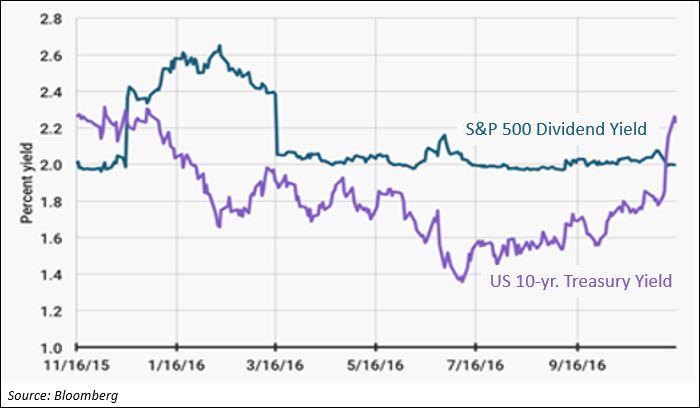
t-rates-vs-stock-yields

Does the crossover of rates indicate that investors should rotate from stocks to bonds? We don’t think so. We believe that stocks can continue to appreciate as corporate revenues and profits grow. There is likely to be an added boost to stock prices if corporations are given a tax holiday to repatriate cash from overseas and use it to buy back shares or declare special dividends.

Meanwhile, in a rising rate environment an investor who keeps bond holdings in short-term maturities has the opportunity to rotate into higher yielding bonds as holdings mature. Rates do not rise in a straight line, so opportunities should arise from time to time.

Remember that you’ve chosen a strategy that is right for your level of risk and return. Do not alter your strategy based on political events or short term swings in the markets. Keep your emotions away from your portfolio, stay patient and invest for the long haul.

To expand on these Market Reflections or to discuss any of our investment portfolios, please do not hesitate to reach out to us at 775-674-2222
Posted on November 21, 2016 Read More

Election Jitters

November has started out to be quite the month. So far:

  • The market has been down 7 days in a row, something that’s happened only 4 times the last 20 years
  • Oil has fallen from a high of $52 to $45 a barrel as an OPEC production cut seems less likely
  • The Presidential campaigns continue to take bizarre turns with both parties
  • And the Cubs won the World Series for the first time since 1908

The bottom line is the S&P 500 has been consolidating since its highs in August. As of today it’s down about 4% off these highs, and it wouldn’t surprise us to see the market correct a bit more. Investors have been unwilling to push stocks higher as they await:

  • The conclusion of 3rd quarter corporate earnings
  • Oil price stabilization
  • The conclusion of the Presidential and Congressional elections

Let’s focus on the elections and how they could potentially affect the markets. Right now, the polls still favor Clinton winning the presidency, but the margin of victory being predicted has narrowed quite dramatically after the FBI decided to reopen the Clinton email investigation. Current consensus thinking for now believes:

The market will take a Clinton victory in stride since she’s a known political entity and begin to focus on the fundamentals again, which are getting better. The market likes continuity and investors could expect a relief rally if she wins.

A Trump victory would bring an element of uncertainty into the markets; investors just aren’t sure what he would bring to the political arena. This uncertainty would most likely lead to a market correction that, in our opinion, would be short lived.

Conventional thinking is that Republicans are better for the markets, but historically markets have performed better under Democratic presidents. Analysts at S&P Capital IQ have found that since 1945 the average annual gain under the Democrats was 9.7%, while under the Republicans it was 6.7%.

The most important question to ask is, “Do election results drive these returns or do the trajectories of the economies and markets already in place drive returns?” Our belief is that politicians tend to INHERIT versus INFLUENCE the stock markets. Proof in point: The poor returns of the Richard Nixon and George Bush eras had more to do with the Arab oil embargo and financial crisis respectively than Republican initiatives. Likewise, the excellent returns of the Barack Obama era most likely were due to the fact he came into office right after the severe market correction of 2008, rather than his party’s initiatives.

This doesn’t mean we shouldn’t be conscious of which party holds office. Certain political initiatives of either a Democratic or Republican administration can weigh on (or favor) certain sectors within the markets. A Clinton administration would weigh on the drug/biotech manufacturers (continued attack on high drug prices) and financial stocks (continued regulation), while it could be favorable for the alternative energy sectors. A Trump win would likely favor the financial, healthcare and defense sectors and be detrimental to the manufacturing sector.

Regardless of who wins, most political strategists predict we’ll still have a Republican House and a Democratic Senate. The checks and balances that a split Congress brings to the table is a constructive setting for stock markets.

Our view is that once the elections are over the market will once again begin to assess the fundamentals. We think these fundamentals are encouraging as we look at an economy that continues to expand, earnings growth that is inflecting from negative to positive and valuations that are not cheap, but reasonable. Finally, we encourage investors to avoid mixing their political feelings and their portfolio decisions; we’ve seen too many negative outcomes when investors mix the two.

To expand on these Market Reflections or to discuss any of our investment portfolios, please do not hesitate to reach out to us at 775-674-2222

Posted on November 3, 2016 Read More

Election Eve

October is usually a challenging month for investors. Once every four years a presidential election cycle adds to the October angst. This year’s emotionally charged political season is no exception as we sit on the eve of a unique election in which both Congress and the presidency could change party affiliation.

Collectively, the markets tend to absorb big news in stride, whereas the individual investor inevitably rides the emotional roller coaster. Think back to the Fiscal Cliff, U.S. debt downgrade, the oil collapse and Brexit as examples of resilient markets filled with fearful investors. After this election, the economy and the financial markets will still be evaluating the same factors driving asset prices today.

The U.S. economy is like a three legged stool. It is supported by the consumer, corporate America and the government. Two of the three legs are on solid footing, but government is the weak leg. After the financial crisis of 2008, the consumer pulled back, deleveraged and eventually righted their ship. Remember the consumer is two-thirds of the economy, so a healthy consumer is critical to a growing economy. Corporate America has been on a massive mission to cut costs and maximize their profitability. The stock market has taken notice. The government’s inability to prudently manage its financial affairs continues to be a drag on economic growth.

As we see it, the consumer holds the key to the economic growth engine. Unfortunately, top speed is likely the one or two percent core growth recently experienced. Government is unlikely to change its ways and corporate America is already lean and looking for top line revenue growth. This leaves the consumer in charge and thankfully strong. September retail sales from the Commerce Department rose 3.4% year over year with core sales (ex-autos) up 2.7%. Restaurant sales were particularly strong, up 6% year over year. Meanwhile retail sales via the internet rose by 11%.

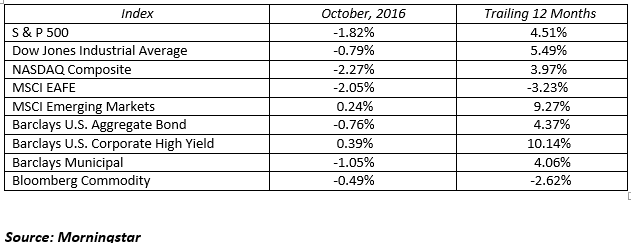
Despite strong consumer news released in October, the U.S. stock market pulled backed for the third consecutive month from their recent record-setting highs. This is not surprising as election concerns took center stage. This too will pass. The S&P 500 had its worst month since January, down 1.82%. Emerging markets eked out a positive 0.24% gain while developed international stocks fell a bit more than the S&P 500, down 2.05% in October.

Corporate earnings season is in full swing, and the results are beginning to show a much awaited turnaround. With year-end fast approaching it’s not too early to think about equities in the upcoming year. We see November and December as a time for the market to digest the election results with sideways price action. Next year, we are hanging our hat on strong consumers and growing corporate profits as the key drivers to a solid year for stocks.

Bond prices fell and yields rose as the benchmark 10-year Treasury rate ended the month at 1.86%, up nearly 23 basis points. We believe the interest rate rise since the end of September reflects the market’s expectations of a small Federal Reserve rate hike in mid-December. While we believe a 25 basis point hike in December is a done deal, don’t be fooled. We expect that the Fed’s future actions will be few and far between. Looking ahead, we expect interest rates to remain low but range bound in a slightly higher range. In 2016 the 10-year U.S. Treasury Note has traded in the 1.50-2.00% range; next year we expect a 2.00-2.50% range as the norm.

The financial journey has many obstacles. On the eve of the election, the markets are handicapping possible outcomes, geopolitical tensions, technical factors, the Federal Reserve and most importantly the constant stream of third quarter corporate earnings announcements. Most of this is market noise. Do not let this noise turn into personal emotion. Stand behind your plan and stay focused on your long-term objectives.

MARKET BY NUMBERS:

Oct2016

To expand on these Market Commentaries or to discuss any of our investment portfolios, please do not hesitate to reach out to us at 775-674-2222

Posted on November 1, 2016 Read More

News Archive