3rd Quarter 2016 Market Review
Third Quarter Market Review
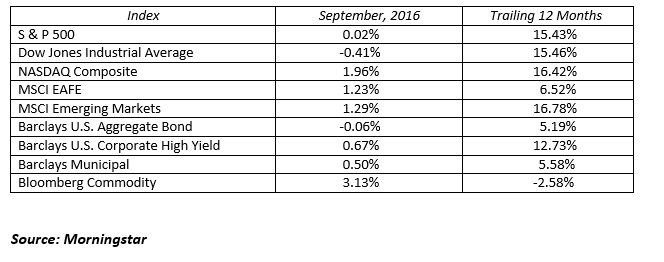
The third quarter had something for everyone. In July, the bulls gloated as the S&P 500 soared to multiple record highs after Brexit concerns quickly faded in the rear view mirror. In August, the markets displayed their typical summer doldrums with low volatility, sideways price action and tight trading ranges. In September, the bears briefly poked their heads up to remind everyone prices can also go down when volatility comes out of hibernation. In the end, the markets once again proved they are resilient.
The resiliency comes from favorable market fundamentals and accommodative central bank policies around the globe. Low short and long-term interest rates continue to support the prices of riskier assets. With interest rates at generational lows, investment is being diverted into riskier assets to achieve a reasonable return. The flow of money into global stock markets is a major reason behind the sustained rally. In addition to low interest rates, corporate profits are improving and the economy is grinding out slow and steady growth. Employment numbers are showing improvement bringing consumer confidence to a nine year high. A strong consumer usually means a strong stock market.
The U.S. Federal Reserve speaks often, but is starting to sound like the boy who cried “wolf”. This is the third quarter this year where the threat of a 25 basis point rate hike remained a threat. In defense of the Federal Reserve, they find themselves in a difficult place. The U.S. is void of any fiscal restraint, and monetary policy alone has limitations. Low and even negative interest rates globally impact the Fed’s ability to raise U.S. short-term rates. While the Fed claims to be non-political, they know an election is just around the corner and would prefer to remain neutral. We expect a 25 basis point hike in December after the dust settles.
As the markets enter the home stretch of 2016, expect the unexpected. Valuations in the stock and bond markets are rich by historical standards. If third quarter earnings beat expectations and interest rates remain low, then the market becomes fairly priced and the bull market can move forward. Any signs of an economic slowdown or central banks raising interest rates could derail the bulls. In addition to the fundamentals, the market will be handicapping the elections, geopolitical events, market technical factors, the October effect and everything else rolling through the news cycle.
It’s been a good year to own financial assets. Periods of strong performance provides a great time to review your portfolio, reassess your risk tolerance and evaluate your emotional state. The fourth quarter could bring higher volatility. If it does, it is better to enter this period mentally strong, fully committed to both your portfolio and time horizon. Remember, financial success is measured in years, not weeks or months.
MARKETS BY THE NUMBERS:
To expand on these Market Commentaries or to discuss any of our investment portfolios, please do not hesitate to reach out to us at 775-674-2222
Market Update
Stock, bond and oil market values have turned up in the last couple of weeks.
The Federal Reserve announced last Wednesday that it will keep interest rates flat for a while longer, in line with our expectations. The last time the Fed raised rates was at its December 2015 meeting and then just to the 0.25-0.50% range. Headline inflation is up just 1.1% year over year as of August, but appears to be moving toward the Fed’s 2% goal. Unemployment remains at 4.9%, half the rate we endured in the last recession. However, economic growth in the second quarter was disappointing, rising just 1.1% year over year.
Bond prices rose on the Fed’s decision to hold rates steady, with the benchmark 10-year Treasury yield falling to 1.56% from 1.70% prior to the report. The stock market also liked the Fed’s decision to hold rates, and the S&P immediately rose by 1%.
Now, however, real GDP growth is expected to accelerate in the current quarter to the 2.5 – 3.5% range. Some of this is attributable to increased farm exports, but other exports and domestic retail sales are also showing signs of improvement. With that comes a more positive outlook for business spending. Inflation remains low, so the inevitable Fed rate hike (in November or December) is likely to be modest, perhaps another 25-50 basis points, in our opinion.
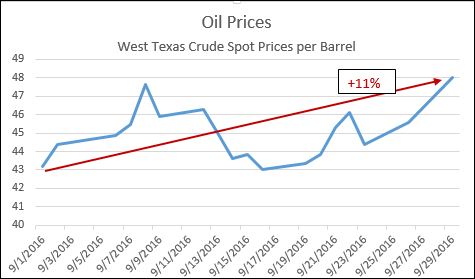
Oil prices have been at the mercy of OPEC production for some time now. With the income of oil producing countries slashed over the last two years on sharply lower oil prices, there has been much speculation that those countries would cut production in an effort to raise oil prices. All indications are that the OPEC members agreed this week (prior to their official meeting in November) to cut production by as much as 20% of current estimated output. This drove oil prices 7% higher in the first 24 hours, and energy stocks rallied.
Source: Thomson Reuters
Apart from the oil sector, we believe third quarter earnings are likely to beat recently lowered expectations. Based on rising U.S. consumer confidence to the highest level in nine years, we expect to see higher consumer spending on domestic goods and services which are the key drivers of the US economy. Exports are rising as the headwinds of a strong U.S. dollar last year have become tailwinds this year, allowing a more level playing field for U.S. manufacturers to sell products overseas with rising sales and profitability.
We believe the stock market could pull back given the rhetoric surrounding the final weeks of what appears to be a close presidential race. We would view such a pullback as as opportunity to add to positions for 2017. Looking out over the next year, we see consensus expectations of low double-digit earnings per share growth. With similar valuations as today’s forward P/E of 17x, that EPS growth is likely to lead to low double-digit gains for the S&P 500.
To expand on these Market Reflections or to discuss any of our investment portfolios, please do not hesitate to reach out to us at 775-674-2222