To Raise or Not To Raise Rates? WHEN, not IF is the Question

It’s been nearly a year since the Federal Reserve raised interest rates, by a modest 25 basis points to the 0.25-0.50% range. Since the day of the raise, there have been many stories in the financial press, with some investors running around crying, “Rates are rising! Rates are rising!” Meanwhile we have been correctly sticking with our “lower for longer” mantra all year. From 2.27% yields on 10-year US government bonds at the beginning of this year, yields actually fell to 1.37% in early July. See chart below.
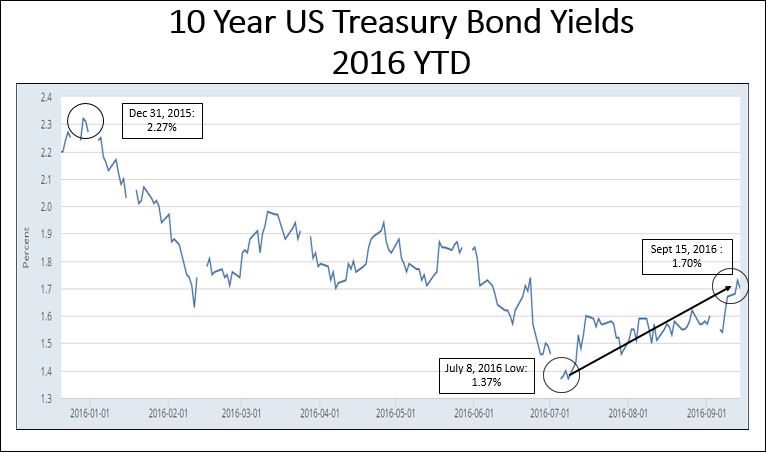
10 yr. Treasury yields 9.16 YTD

Source: Federal Reserve Bank of St. Louis

As we analyze the data, we have seen our economy pick up very gradually this year. Why? Energy pricing tailwinds have dissipated, the dollar has flattened out and exports have improved. Real GDP rose just 1.1% in the second quarter of 2016, and the deficit dropped by 12% in July. Economic growth over the balance of the year is likely to remain modest, below the 2% mark.

We have seen unemployment drop to the 4.9% level, but have not seen consistent employment and wage growth rates. On the inflation front, the core rate remains below the Fed’s 2% target. None of this points to the usual reasons for a rate hike: curbing growth that is de-stabilizing our economy or curbing runaway inflation.

The last time the Fed met in June was just days after the markets were unsettled by the British voters’ decision to leave the European Economic Union, or Brexit. In prior statements the Fed noted their discomfort with overseas economies as a reason to put off rate hikes, and Brexit was mentioned as one of the reasons for their restraint in June.

With nearly 100 days left to the year, a lot could still happen. But with the Federal Reserve meeting in just a few days (September 20-21), we would be very surprised if they were to raise rates based on the US data.

However, bond yields have been rising in recent days on improving global growth metrics. We believe the Fed will eventually follow, although not this month. We’ll know for sure very soon.

Are higher interest rates necessarily negative for stock prices? Actually, we believe this improvement in global economies should be positive for stocks since rising economies lead to rising corporate earnings and would make current valuations appear attractive. The threat of higher interest rates has been pressuring S&P 500 in recent weeks, and in doing so we believe it has created an opportunity to add to stock portfolios in select sectors.

To expand on these Market Reflections or to discuss any of our investment portfolios, please do not hesitate to reach out to us at 775-674-2222
 

Posted on September 21, 2016 Read More

August Economic Slowdown?

At Nevada Retirement Planners we monitor the fundamentals of the market continually. To review, we believe that long-term stock prices are driven by 3 broad fundamental metrics, they are:

  • The health of the economy
  • The profitability of the companies operating within the economy
  • Market and individual stock price valuations

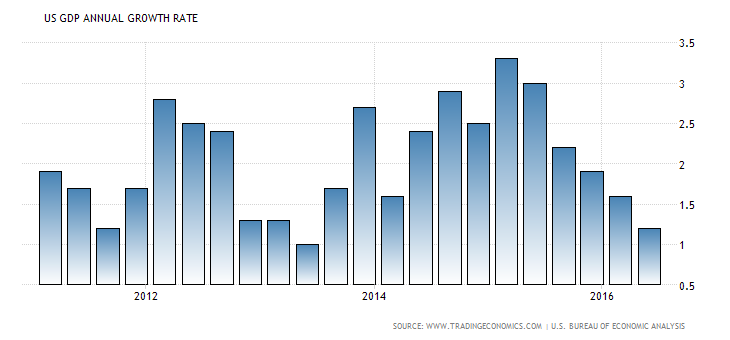
Today let’s do a quick review of the economy. One of the broadest measures of the economy is Gross Domestic Product (GDP). GDP has been growing at a moderate (and fairly stable) pace the last five years. The chart below illustrates how the US economy has been growing between 1% and 3% on an annual basis.

9_1

Recently the GDP growth rate has slowed down closer to the 1% range. This is concerning if the growth rate doesn’t accelerate. A reading over 2% is much more indicative of a healthier economy. Let’s break down our economy into two broad sectors.

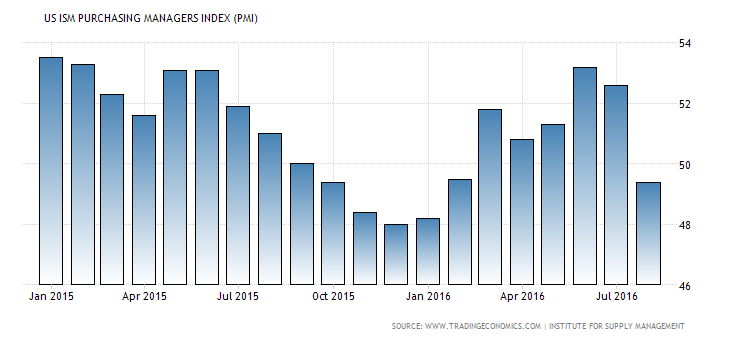
First, the manufacturing sector of the economy has been dwindling over time, but is still important and comprises roughly 12% of the US economy. Every month the “Institute for Supply Management”, or ISM, reports a PMI index which highlights economic activity in the manufacturing sector. A reading above 50% indicates that the manufacturing economy is generally expanding, below 50% indicates that it is generally contracting. In August the PMI came in at 49.4% down from 52.6% in July. The chart below highlights that the manufacturing PMI has not been below 50% (the border between expansion and contraction) since February of 2016.

9_2

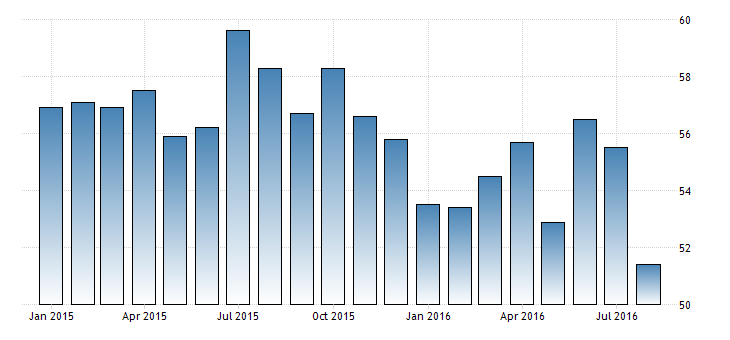
Secondly, we need to look at ISM’s PMI index for the all-important services sector of our economy. The US service sector slowed to a six-year low in August, according to ISM. The PMI index on the service sector came in at 51.4% for August, down from 55.5% in July. That’s still growth, but it’s the lowest reading since February 2010, when the index pulled out of contractionary territory for good following the 2008 financial crisis. See the chart below highlighting service sector PMI readings.

9_3

The August slowdowns in both the manufacturing and services sector of the economy point to a potential anemic GDP growth rate again in the 3rd quarter of 2016. In fact, Chris Williamson (Chief economist of Markit) says “taken together, the manufacturing and services PMIs are pointing to an annualized GDP growth rate of a mere 1%, suggesting that those looking for a strengthening in the rate of economic growth will be disappointed once again”.

Monthly data can be volatile, especially during the summer. But we’ll certainly be keeping an eye on upcoming economic reports to determine if the August slowdown was an outlier or a trend.

To expand on these Market Reflections or to discuss any of our investment portfolios, please do not hesitate to reach out to us at 775-674-2222
Posted on September 13, 2016 Read More

Go For The Gold

The markets and the Olympics shared some commonalities this month. Records are being broken on a daily basis, very few spectators are attending the actual events and it does not have quite the same buzz as past Olympics. Same can be said for the financial markets as record cash sits on the sidelines waiting for the next 2008. For the first time since 1999, all three major U.S. stocks market indices closed in record breaking territory on the same day. This is quite a turnaround from the start of the year when global markets tumbled. The questions are: how did we get here and what keeps the markets moving higher?

Global central banks explain some of the market strength as they continue to support risky assets with easy monetary policies. Investors are skeptical that the U.S. Federal Reserve will raise interest rates soon, while central banks in Europe and Japan have loosened monetary policy this year. This has left global stocks higher and bond yields at all-time lows. Stable oil prices and currency valuations are also giving stocks support. Oil prices rebounded to the mid-$40’s per barrel on expectations that the Saudis will push for limited production at the next OPEC meeting. The 2015 strengthening in the U.S. dollar has been replaced with relative calm. The stable dollar is helping U.S. corporate earnings as 70 percent of companies have reported quarterly earnings above the mean estimate, according to FactSet.

The economic numbers in August were generally good, and even weak economic news has been interpreted as good news for the market. Weak retail numbers showed sales growth was flat in July, and strengthened investors’ belief that the Fed is unlikely to raise rates when it meets next month. Good news has been treated as good news too. Inflation as measured by the CPI remains well below the Fed’s 2 percent target. The 0.5 percent gain in manufacturing output in July may be an indication last’s year’s dollar surge is behind us. Consumer confidence remains high in August with a reading in the low 90’s. The July employment report showed a second consecutive month of strong job growth.

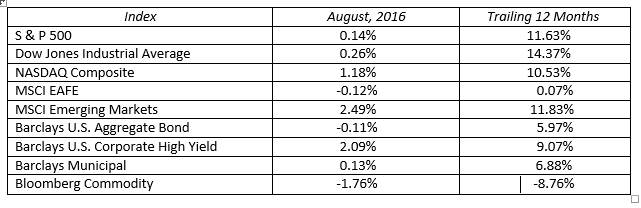
All things considered, the markets seem to be in their happy place. The combination of slow growth, low interest rates, accommodative central banks, recovering energy prices and stable currency has been a recipe for appreciation. For the month all major stock indices posted small gains, both here and abroad. The leading sectors were financials, energy and technology.

The yield on the 10-year U.S. Treasury Note traded in a very tight range, starting the month at a 1.49 percent yield and ending the month at a 1.57 percent. The Fed’s play book appears to be a repeat of last year as they likely implement one 25 basis point rate hike prior to year-end. The only real question is timing. Will it be a pre-election September or a post-election December move?

If you want to be an Olympian investor and go for the gold, you need to bring a similar level of discipline and commitment to your investment program. The spectator sees the champion athlete on the podium receiving their medal, but does not appreciate the hard work and sacrifice expended in achieving the reward. Success takes a lot of hard work and a little bit of luck. The journey to reach your financial goals takes time, patience, hard work and a positive attitude. Like the devoted athlete, keep striving to make your financial plan the best it can be.

MARKETS BY THE NUMBERS:

Capture

To expand on these Market Commentaries or to discuss any of our investment portfolios, please do not hesitate to reach out to us at 775-674-2222
Posted on September 1, 2016 Read More

News Archive