Will Household Debt Curb Economic Growth? It’s All Relative

Household debt (mortgages, auto loans, credit card debt, etc.) is near its 2008 peak. That’s a headline sure to make many people pause.

Digging into the numbers, one can find that growth in jobs, household income and declining interest rates means that consumers are now in a far more robust situation to pay down that debt. Add in lower cost of energy (both for heating/cooling and weekly gas purchases), and you have even more disposable income. Therefore delinquencies as a portion of total loans are low and stable, which should give investors a sense of relief.

Some will acknowledge that sub-prime lending (loans to those with less than a 600 credit score) for home mortgages has been dialed down post the recession. But they will argue that sub-prime lending for auto purchases are dialed up. Here also, the positive news on higher incomes and lower interest rates apply. While the absolute level of auto loans is higher than the peak in 2006, the portion of disposable income that they represent is well below that of 2006.

Meanwhile home prices, which expanded to bubble proportions in ’08, are rising at a more modest rate in recent months. Sales (and new mortgages) are being restrained by a lack of inventory, both for new homes and existing homes, which is neutral to our economic growth.

As consumer spending accounts for about 70% of total gross domestic product (GDP), the consumers’ heightened ability to pay down debt is a tailwind for our total economic growth.

What about borrowings in the US overall? The debt to GDP ratio remains high if you look at the last 60 years (see chart below). However, the highest levels were due to increased government debt in the wake of the recession, and they have been coming down in each of the last five years. We view current conditions to be healthy for further declines in the rate and positive for U.S. economic growth.
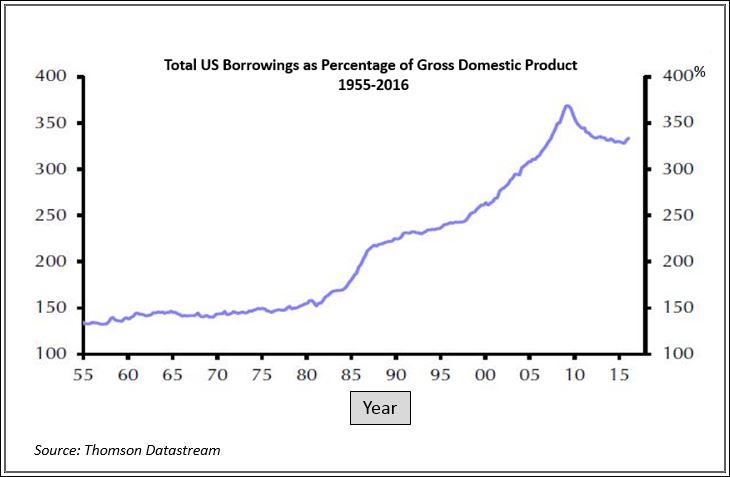
Debt to GDP

To expand on these Market Reflections or to discuss any of our investment portfolios, please do not hesitate to reach out to us at 775-674-2222
Posted on August 26, 2016 Read More

Gradient in the News – Market Done with 2016 Gains?

Posted on August 26, 2016 Read More

Market Volatility (time to panic or profit)

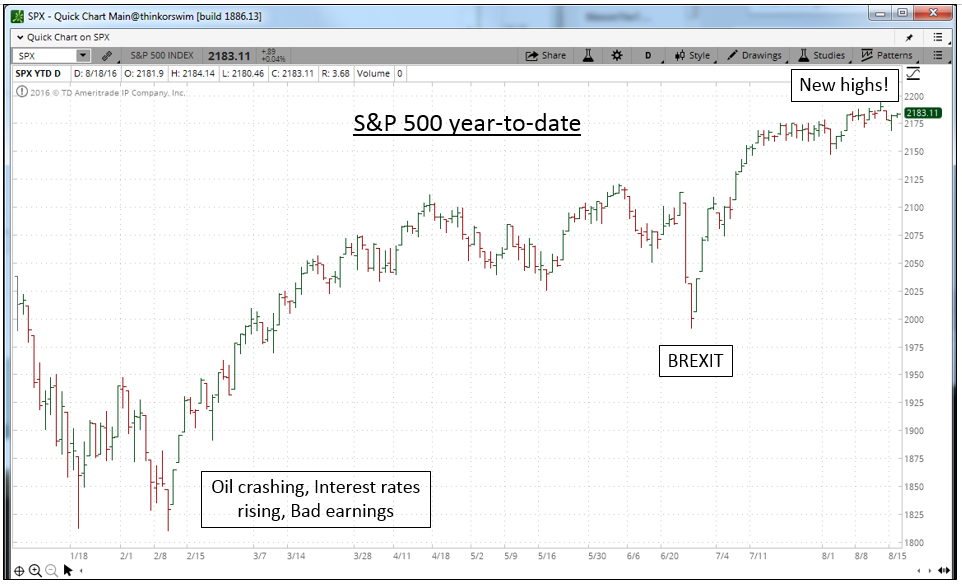
2016 has been an interesting year in global stock markets. Volatility has increased, but so has performance returns in most global markets. The volatility was anticipated as many investors and strategists were somewhat pessimistic coming into the year. Their reasons were several:

  • Oil prices were crashing
  • The Fed was looking to normalize (raise) interest rates
  • Corporate earnings were forecast to decline on a year over year basis
  • Market valuations were above their 10 year averages
  • China’s economic slowdown and Europe’s economic malaise

Our forecast that 2016 would provide positive returns in the U.S. markets, roughly mid-single digits (which means 4-6%). At the beginning of the year our forecast looked aggressive, but currently the S&P 500 is up about 8%, and dividend paying/blue chip stocks have performed even better. 2016 has surprised many investors and the stronger returns have left many institutional equity managers scrambling as they find themselves trailing the indices.

sp ytd
Despite the increased volatility, investor pessimism, and negative headlines U.S. stock markets are hitting all-time highs. What’s driving the strong returns? Well, even with amplified market volatility and minor market corrections:

  • The global economy continues to show moderate and steady growth
  • The Fed and other global central banks are keeping interest rates low
  • Oil prices recovered
  • BREXIT fears appear to be greatly over exaggerated

The bottom line is that there will always be noise in the markets, there will always be corrections too. A great example of this is the turbulence BREXIT caused. Right after the surprise BREXIT vote, global investors decided to sell first and analyze the situation second. This was a mistake. Often these situations can create opportunity, occasionally they are pertinent to the trajectory of market fundamentals. Our approach is to assess the situation, determine how it affects portfolio performance and, if needed, take action. Following this process the investment management team can determine if situations (like BREXIT) deem investment adjustments or not.

To expand on these Market Reflections or to discuss any of our investment portfolios, please do not hesitate to reach out to us at 775-674-2222

Posted on August 19, 2016 Read More

News Archive