Back on Track

On the heels of a terrible month in the stock market, the market righted itself keeping the wounded bull alive.  The fourth quarter’s swift and painful stock correction proved an opportunity to buy stocks at clearance prices.  The New Year brought renewed hope as interest rates remained stable and stock prices began to rise from some oversold conditions.

The main catalysts for this much needed turnaround were:

  • A change of perspective at the Federal Reserve Bank. The comments coming from the Fed throughout the fourth quarter were very hawkish.  They were clearly on a mission to raise the fed funds rate with regularity and had the balance sheet reduction program (a.k.a. Quantitative Tightening QT) on auto pilot.  After the December rout, they lightened their language to a more dovish stance emphasizing patience and data monitoring. The market breathed a sigh of relief.
  • Corporate earnings season began.  The early read here has produced mixed results, but overall expectations are for 5-10% earnings growth this year.  This is good news for stock prices, especially in light of the lower valuations coming out of year end.
  • A glimmer of hope on China trade. The U.S. and China are having high level in-depth meetings leaving investors with the belief some trade resolution is possible. This is a complex multifaceted issue that will take years to completely resolve, but there are signs tariff escalations can be halted and some preliminary agreements reached.
  • The government is back in business (for now). The partial government shutdown was more of a political event and less of an economic event, but it does remove a barrier for now and possibly will lead to new headlines about things that matter. 

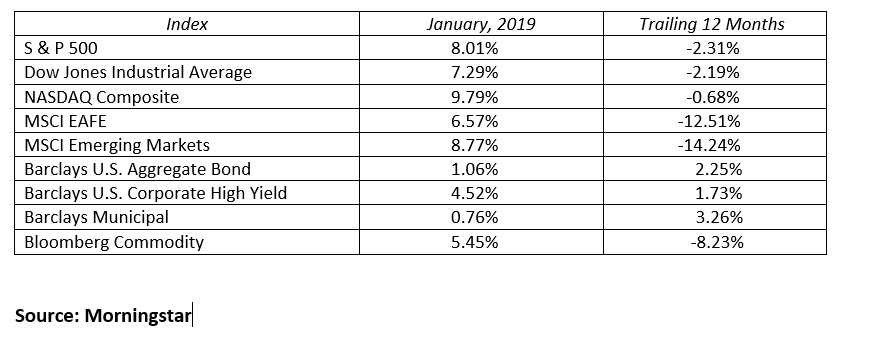
The January stock rally has been a traditional “risk on” trade as high beta and small capitalization stocks outperformed low volatility and large capitalization companies.  This stock market turnaround has been a complete reversal from what we saw during the fourth quarter correction.  Reported fourth quarter earnings and more importantly, 2019 earnings guidance, are behind many individual stock price movements. The market swiftly rewarded companies exceeding expectations (Apple, Boeing, IBM, Bank of America, and VF Corporation) and punished those falling short of expectations (Abbvie, Caterpillar, Bristol Meyers Squibb).  The NASDAQ Composite, S&P 500 and the Dow Jones Industrial Average gained 9.8%, 8.0%, and 7.3% respectively in January.  International stocks also had am impressive month as the MSCI EFAE and emerging markets indices produced gains of 6.6% and 8.8% in January.

The first Federal Open Market Committee meeting, held in late January, kept the fed funds rate unchanged as expected and the Fed reiterated their new found “wait and see” language.  The stock and bond market has embraced the new and improved patient Fed.  The benchmark 10-Year U.S. Treasury traded in a very tight range around a 2.72% yield, but rallied into month end after the FOMC meeting.  It closed the month yielding 2.63%, down 6 basis point since year end.  The yield curve retained its relatively flat, but still positively sloped shape. The 2-year Treasury fell by 3 basis points to end the month yielding 2.45%.  Meanwhile, the 30-Year Treasury also fell 3 basis points to yield 2.99%.  The yield curve shows a modest inversion at the 2-5 year segment of the curve, but for now, the overall curve remains positively sloped.

As we look ahead to the next eleven months of the year, here are the major themes we see playing out in the economy, stock market, and the bond market:

  • The U.S. economy continues to expand, but at a slower pace than 2018.
  • International economies display moderating, but still positive growth.
  • Corporate earnings continue to grow this year in the 5-10% range.
  • Interest rates remain relatively stable with the 10-year U.S. Treasury yield approaching 3%.
  • The Federal Reserve will slow their pace of rate hikes this year (one 25 basis point move higher in the second half of the year).
  • Stock market volatility remains elevated in 2019.
  • Expect stocks to return 4-6% and bonds 1-3% this year.

Remain patient with your investment portfolio.  Your patience will likely be tested a few times this year.  If your portfolio is properly balanced at the appropriate risk level, you will be much better equipped to deal with the market’s volatility and subsequent emotional challenges.  At the margin, investors can add some risk after a 10-15% correction and can reduce risk when the market revisits new all-time highs.  In lieu of a marginal trading strategy, just peg your risk tolerance level and stay fully invested throughout tomorrow’s highs and lows.  

MARKETS BY THE NUMBERS:
To expand on these Market Commentaries or to discuss any of our investment portfolios, please do not hesitate to reach out to us at 775-674-2222
Posted on February 4, 2019 Read More

2018: A Difficult Year For Markets

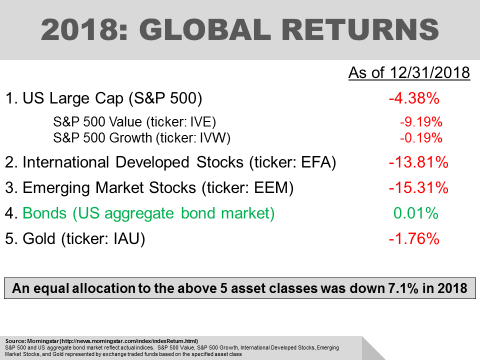
In 2018, most asset classes ended the year in negative territory.  US bonds finished the year just barely in positive territory (+0.01%), while all others listed below were negative.  Based on the below chart, a diversified portfolio consisting of the included 5 asset classes, would have been down over 7% in 2018.

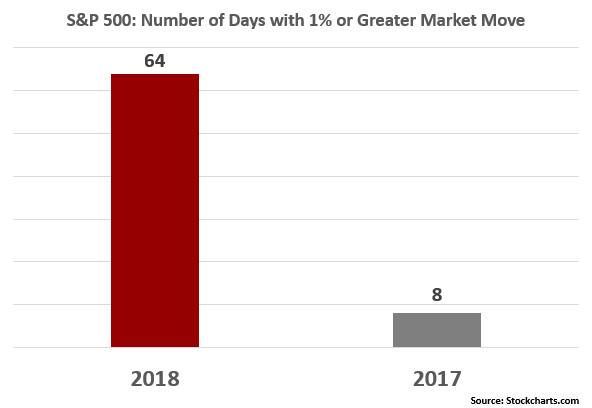
Also, the chart below shows the return of volatility in stock markets in 2018.  2017 was an abnormal market in terms of lack of volatility, with 8 instances of greater than 1% daily moves (up or down) in the S&P 500.  In 2018, the number dramatically increased to 64 days.

As we look to 2019, we have begun the year with several uncertainties that could create further volatility.  These include:

  • A US government shutdown
  • Oil prices that have fallen aggressively
  • The threat of tariffs and continued trade tensions
  • The potential for slowing economies, both the US and abroad
  • The threat of slowing corporate earnings

While the reasons can be different, the fact is uncertainties are commonplace in the stock markets.  We will always have risk and be faced with unknowns that can swiftly change the course of the markets in the short term.  This is not new.  Because of this, timing the market is extraordinarily difficult and usually destroys value over time.

There are, however, actions that create value for investors over longer periods.  Those are:

  • Having an investment plan that considers your specific objectives, needs, and risk tolerance
  • Diversifying among assets, including both safe assets and higher growth / higher risk assets
  • Periodically rebalancing portfolios back to their proper asset allocation

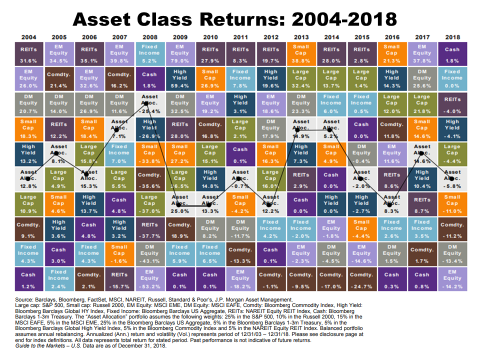
Remember, diversification works over time, not all the time.  Being properly diversified means some assets will be outperforming your portfolio, while others will be underperforming.  However, the chart below reflects that asset leaders and laggards vary significantly from year to year, and significantly shifting assets toward what worked in the past is generally a losing proposition.

To expand on these Market Reflections or to discuss any of our investment portfolios, please do not hesitate to reach out to us at 775-674-2222.

Posted on January 16, 2019 Read More

Fourth Quarter Review

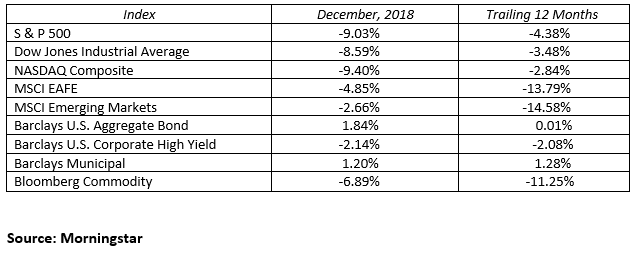
The final quarter of 2018 had the feel of the highly volatile first quarter.  The year began with enthusiasm as lower taxes sent stocks to all-time highs.  This euphoria quickly subsided and morphed into a rapid 10% price correction.  Entering the fourth quarter, major U.S. stock market indices had reached new all-time record highs, only to finish the year with another round of gut-wrenching declines.  This time the correction reduced S&P 500 values by 13.5% for the quarter and ended down 4.38% for the year.

The fourth quarter left a mark on both client assets and their psyche. Wild price swings are uncomfortable even for the most seasoned investors.  Heightened volatility came from many sources.  This time the list included higher short-term interest rates, the Federal Reserve’s tightening monetary policies and hawkish comments, potential for an inverted yield curve, trade tensions between the U.S. and China, a government shutdown, slower global economic growth, falling oil prices, politics and simple old-fashioned fear.  Through time, the market cycles from rising prices to price corrections that eventually pave the way for future upside potential.  The pathway to a better 2019 will be built on a foundation of strong economic fundamentals.  Consumer confidence remains high, unemployment is low at 3.7%, corporate earnings are expected to grow 8-10% next year, and GDP growth is expected to be in the 2.0-2.5% range with low inflation.

Solid economic fundamentals did not deter this quarter’s painful price correction.  Stocks largely went into freefall from highs set in September.  The major indices experienced fear-inducing declines.  The NASDAQ Composite, S&P 500 and the Dow Jones Industrial Average lost 17.3%, 13.5%, and 11.3% respectively in the fourth quarter.  International stocks also struggled as the MSCI EAFE and emerging markets indices produced losses of 12.5% and 7.5% for the quarter.  The high flying “FAANG” stocks that carried the markets to new highs over the past nine years were hit hard.  Amazon, Apple, Alphabet (Google), Facebook, and Netflix experienced quarterly declines between 13.4% and 30.6%.

When stocks fall, bonds usually provide some portfolio relief.  Thankfully, investment grade and treasury bonds did that in the quarter.  Despite a fourth 25 basis point rate hike to the fed funds rate this year, the Bloomberg Barclays Aggregate bond index managed a positive 1.6% return for the quarter.  Unfortunately, high yield bonds suffered along with stocks, declining 4.5% in the fourth quarter.  The benchmark 10-Year U.S. Treasury fell below 3% yield in the fourth quarter, declining by 36 basis points to end the year yielding 2.69%. The yield curve flattened on the short end and steepened on the long end as the 2-Year Treasury fell by 33 basis points to end the quarter yielding 2.48%.  Meanwhile, the 30-Year Treasury fell 17 basis points to yield 3.02%.  The yield curve showed its first signs of inversion as the 2-5 year segment of the curve temporarily inverted, but for now the overall curve remains positively sloped.

We consistently preach the necessity to remain focused on your long-term financial goals.  A violent correction, like the one just experienced, creates fear.  If left unchecked, fear will cause well-intended long-term investors to sell low and buy back at higher prices.  It takes courage and commitment, but it is important to avoid this very-common investor pitfall.  Hopefully, your financial plan has been carefully constructed with your long-term goals and risk tolerance levels in mind.  Staying the course in the face of fear is challenging but necessary to achieve your long-term objectives.  The pain here is real, but time will eventually heal these wounds.  Starting 2019 after a fairly significant correction in 2018 energizes our outlook for the New Year, as we forecast generally stable interest rates and mid-to-high single digit stock returns.

MARKETS BY THE NUMBERS:

To expand on these Market Commentaries or to discuss any of our investment portfolios, please do not hesitate to reach out to us at 775-674-2222
Posted on January 9, 2019 Read More