Year of the Monkey

The Chinese New Year was celebrated in early February and enter the year of the monkey. After the celebration the Chinese stock market rallied in true New Year’s fashion. Their enthusiasm spread to both the European and U.S. stock markets giving the world a much needed boost from the current pullback.

All the recent attention to China reminds me of a fabulous Chinese Proverb. “The best time to plant a tree was twenty years ago. The second best time is now.” When advisors and clients inquire about the best time to buy stocks or invest money, a confident and truthful response can always be “the best time to invest was twenty years ago, the second best time is now.” The twenty year time horizon gives the proper perspective to a long-term mission. The proverb also instills hope. Long-term goals can be achieved if you start the process and stay committed.

The January stock market sell-off continued into early February. By the eleventh day, U.S. stocks bottomed and mounted a rebound turning negative results into flat returns for the month. International stocks followed a similar path and posted small declines in February. One thing for sure this year is higher volatility. Triple digit moves on the Dow Jones Industrial Average is now commonplace. This trend is likely to continue as the Federal Reserve charts a globally divergent course on monetary policy, oil prices remain uncertain, currencies are in flux, economic growth is fragile, geopolitical risks run high and the 2016 election cycle appears to be one for the ages. Expect volatility to remain high this year.

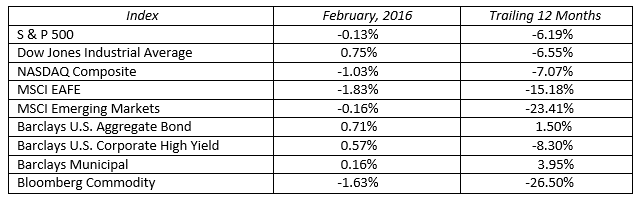
U.S. stocks finished mixed for the month as larger capitalization stocks outperformed smaller capitalization stocks. The S&P 500 and NASDAQ Composite finished down 0.13 and 1.03 percent respectively, while the Dow Jones was up 0.75 percent. International stocks as measured by the MSCI EAFE and Emerging Markets were down fractionally at 1.83 and 0.16 percent. New leadership emerged from the defensive sectors as utilities, metals and mining and consumer staples led the market back to flat for the month.

The equity market rebound pumped life back into credit sensitive bond sectors. High yield bonds, battered from the recent flight to quality trade, reached valuations too cheap to ignore. The February wide credit spread mark (as measured by the Bank of America Merrill Lynch US High Yield Master Spread) reached 8.87 percent on the day stocks traded at their monthly lows. In the last two and a half weeks, high yield spreads tightened over one hundred basis points bringing high yield bond prices back to their monthly starting point. This is good news for bond investors.

The 2016 bond market will provide relative cover for those investors looking for a break from higher volatility. Expect one 25 basis point Fed rate hike in the second half of the year and overall interest rates to remain low, just as they did last year. One to three percent total returns should be your bond market expectations from here.

A closing thought in the face of higher market volatility. It is important to remember capital markets do not move up or down in straight lines. Since March, 2009, the stock market rally has been quite remarkable. Along with success, comes regular price pullbacks along the way. The recent 10.4 percent pullback is no exception. As you can see below there have been thirteen other pullbacks as the S&P 500 journeyed from 666 to 1,932 over the past seven years.
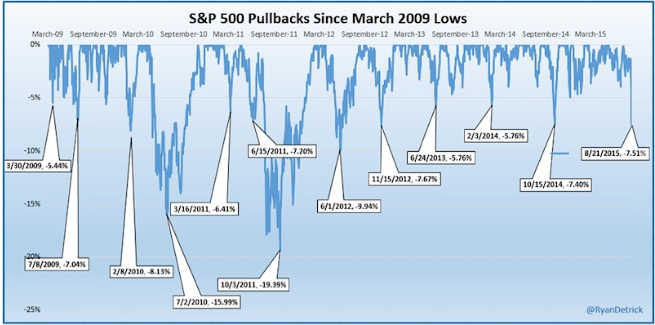
Pullbackssince2009

The secret to the long-term success of planting trees twenty years ago is the commitment to leave the trees in the ground for the entire time. The secret to the long-term success of investing is the ability to stay invested for the entire time. Unfortunately, every market pullback becomes an emotional challenge to your financial commitment. Since it is the year of the monkey, take the monkey off your back and keep your investments planted for the long haul.

MARKETS BY THE NUMBERS:
Feb2016

To expand on these Market Commentaries or to discuss any of our investment portfolios, please do not hesitate to reach out to us at 775-674-2222
Posted on March 2, 2016 Read More

Why Include Gold in Your Portfolio Now?

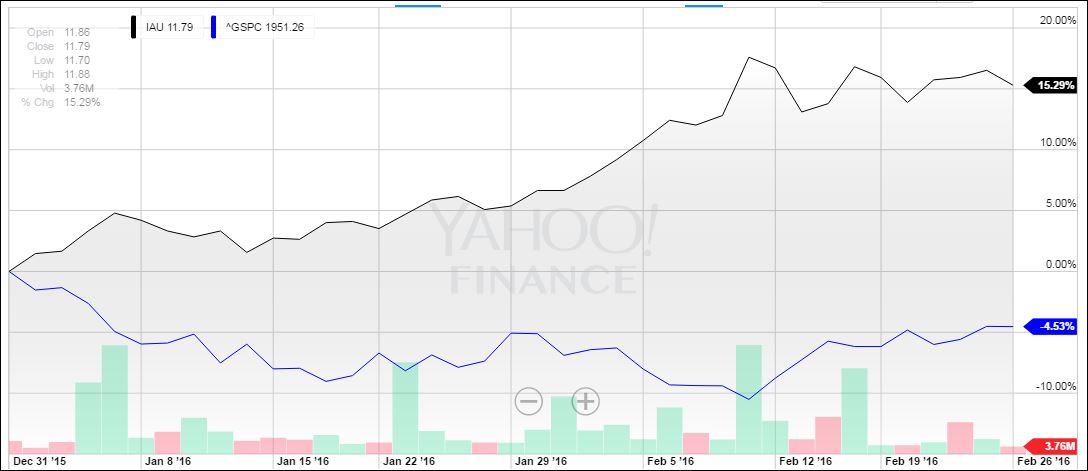
Gold serves several purposes in a portfolio. For the last four years, there has not been much interest in the metal, but investors have been buying recently.

In fact, the price of gold is up 15% year to date, its best start to a year in 35 years as it outperformed stocks. See chart below* illustrating the performance of Gold (black line) versus the S&P 500 (blue line).

Feb 16 Monthly Reflection 1

What’s driving the gains after years of under-performance? It’s the various roles that gold serves:

a) risk reducer in a volatile environment
b) protection against inflation
c) retention of purchasing power
d) protection against any possible decline in the U.S. dollar
e) a safe haven from “black swan” events

Let’s take a deeper look into each of these roles.

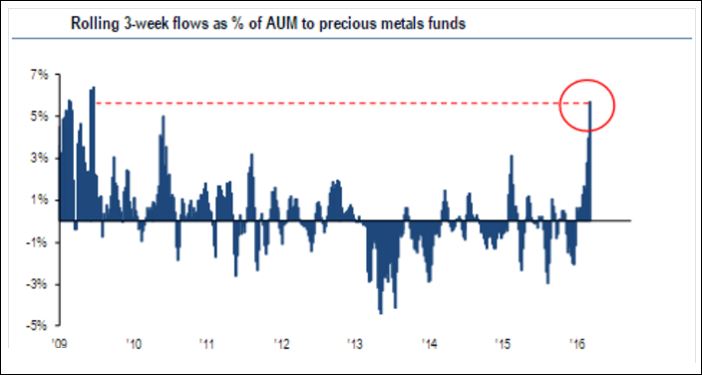
a) Gold is a non-correlated asset class, meaning that it doesn’t move in the same direction as the price of stocks or the price of bonds. The addition of gold can potentially reduce risk in a portfolio. In a volatile environment, as we saw in the Chinese stock market at the beginning of the year, it is actively sought out. We saw this in the sharp rise in money flows to precious metals funds in the first several weeks of this year as shown in the chart below.** Inflows haven’t been this strong since 2009.

Gold Money Flows

b) Gold protects against inflation as it retains purchasing power by rising in value during inflationary times.

c) A handful of countries overseas are actually charging customers to keep their money in a bank these days, a complete reversal of traditional interest payments to depositors. Fear that this new practice will occur in the US as well is partly responsible for the recent gains in gold prices.

d) Gold protects against declines in local currencies. In fact, it often moves in the opposite direction of the US dollar. The US dollar has strengthened over the last two years versus most of the world’s currencies. If this reverses, we believe investors would benefit with a position in gold.

e) In the event of global upheaval, be it caused by terrorist attacks, war or any other unexpected geopolitical or financial shock, gold can be relied upon as a store of value. During these “black swan events”, gold prices rise as the metal becomes a go-to currency.

Currently gold is still less than 1% of global investors’ portfolios. It continues to be under-owned despite the recent price appreciation. With limited supply, this leaves the potential for further price appreciation. You could buy gold bars, metal coins, stocks or mutual funds holding gold miners. Exchange traded funds (ETFs) provide flexibility since they are priced daily, are highly liquid and track the price of gold accurately.

At Nevada Retirement Planners, we currently include a gold ETF in our Endowment Series. Gradient’s Precious Metals portfolio is our most direct method to benefit from higher precious metals prices. The portfolio includes positions in gold along with silver, platinum and palladium. In addition, precious metal mining company stocks are included.

In summary, precious metal investing can be volatile, but a reasonable allocation to this asset class over time can be beneficial.

To expand on these Market Reflections or discuss any of our investment portfolios, please do not hesitate to reach out to us at 775-674-2222
Sources:

* Yahoo Finance interactive charts ** Bank of America Merrill Lynch, EPFR Global

Posted on March 1, 2016 Read More

Where Do We Go From Here?

Investors around the world are concerned these days about the stock markets and their respective economies. The laundry list of concerns is lengthy and includes:

  • Global economic slowdowns, especially in manufacturing
  • Looming recession in the US and other countries
  • Bond market, and more specifically high yield, credit deterioration
  • Federal Reserve interest rate policy direction
  • Low oil prices and the threat of deflation
  • The Chinese stock market crash
  • Concerns over the big European banks
  • And finally, 4th quarter 2015 earnings that were at best in line with expectations

This list of concerns is long and has challenged the fortitude of investors. In 2016 both selling and volatility has increased. Because of this the financial news networks are of course fanning the flames of anxiety among investors.

  • In my opinion the general fundamentals of both global economies and investment markets have somewhat deteriorated
  • It is also my opinion that global stock markets have “already reflected” these concerns

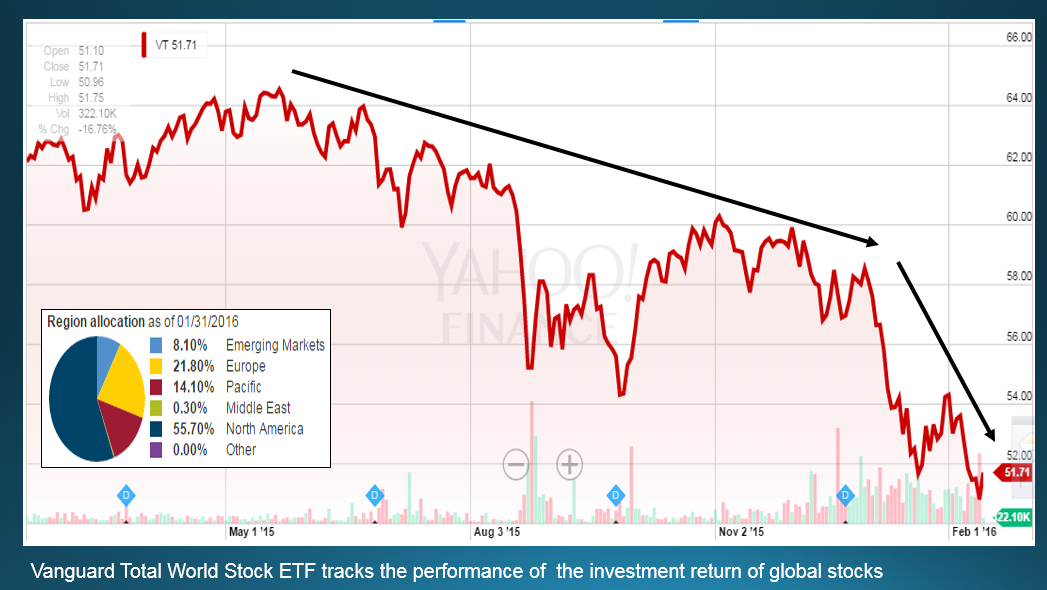
Look at the chart below reflecting the declines of global stock markets the past 9 months:
global market decline
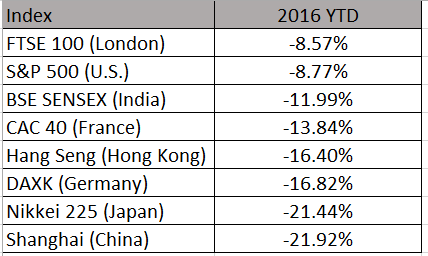
And below is a table of global indices illustrating YTD 2016 performance as of February 12th:
Return tables
We see that global stock markets have been declining since May of 2015, and the decline has accelerated in 2016. Collectively, markets are down roughly 20% across the globe from their peaks.

The big question is where do we go from here? Are the weakened fundamentals pointing towards a global recession? Will the markets continue to cascade further? We don’t think so, in fact we believe the US economy is experiencing a slowdown, not a recession, caused by declining oil prices, a strong dollar, weaker international economies and a pause in the growth of corporate profits. We also think this slowdown is more than adequately reflected in lower stock prices.

Going forward we’re encouraged by recent data that point to continued expansion of the US economy. They include:

  • Continued housing market strength
  • An acceleration in consumer spending
  • A decline in the unemployment rate
  • An acceleration in wage inflation
  • An increase in consumer confidence
  • Bank lending at its strongest levels since the financial crisis

In addition, equity market valuations are much more reasonable, U.S. corporate earnings are forecast to grow again in 2016, global banking system capital measures are strong and oil just had its biggest one day rally since 2009.

The bears have had their way recently. Yes, everything is not perfect in the global economy and their investment markets, but there never is a perfect environment. As the slowdown fades and global growth resumes I believe markets are oversold and due for a rally.

Posted on February 17, 2016 Read More

News Archive