Waiting Game

Investing requires patience. Investors usually desire instant gratification on their portfolio decisions, but the market moves on its own timetable. The markets are currently supplying the bulls and bears with ammunition for their cause, and investor patience is being tested every day. The bears are waiting for an elusive ten percent price correction, while the bulls are waiting for stronger global economic growth and meaningful top line corporate revenue growth.

The waiting game is playing out in multiple markets. In the U.S. stock market, we wait for quarterly corporate earnings to justify current stock market valuations. So far, overall second quarter corporate earnings have been positive, but the market has clearly delineated the winners from the losers based on company specific results. The breath of the U.S. is very thin with a handful of stocks supporting the overall market. In the international stock markets, we wait and watch the news from Greece, Europe and China to see how these issues will resolve themselves. In the commodities markets, the story is a strong dollar and declining commodity prices. We wait to see if gold and oil will bottom here or continue their downtrend. We question how strong the dollar will become in this strengthening cycle.

In the U.S. fixed income markets, the Federal Reserve is stringing the markets along regarding the timing of a 25 basis point fed funds rate hike. This year and a half debate continues and investors now speculate whether the inevitable happens in September, December or early 2016. December seems most likely to me, but this well-telegraphed move will be a nonevent. Remember the market is fretting about a move from zero to 0.25 percent after spending six years at zero. More interesting will be what the Fed reveals in the first meeting following the eventual rate hike.

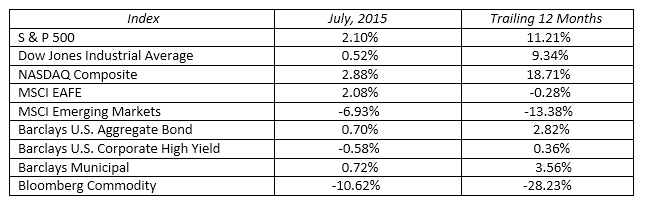
In the first month of the third quarter, results in the stock markets were generally positive with the exception of the emerging markets which fell 6.93 percent. A slowdown in China and concerns about Greece’s financial survival and continued inclusion in the European Union sent shock waves through the emerging markets. The U.S and international developed stock markets were able to reverse the small losses incurred in June. Commodities continued to get pounded as oil prices slipped back into the forty dollar range and gold hit new recent lows. The broad Bloomberg commodity index fell 10.63 percent in July alone.

The U.S. bond market enjoyed a positive month as interest rates declined for bonds that have five years or more to maturity, causing the yield curve to flatten. This is a reversal as compared to recent months where longer term rates rose and the yield curve steepened. The short end of the yield curve increased one to six basis points, and longer maturity rates moved marginally lower. The 10-year U.S. Treasury declined 15 basis points to yield 2.20 percent, and the 30-year was down 19 basis point to yield 2.92 percent.

Flat markets test patience. The sideways action in the financial markets over the past few months can wear on investor confidence. Successful long-term investors have clear goals and objectives, remain focused on their long-term goals and exercise patience during the journey. Realistic return expectations plus appropriate time horizons and patience equals success. The remainder of 2015 will continue to test investor patience. In 2016, the year-over-year comparisons will become more market friendly as the strong dollar and oil price decline will have been over a year in the making.

MARKET BY THE NUMBERS:
august 5th

Posted on August 5, 2015 Read More

Headwinds Becoming Tailwinds: Earnings Growth is Forecast to Accelerate

Consensus earnings for the S&P 500 are expected to decline 3% for the quarter ended June, the largest decline since the third quarter of 2009 when earnings were down 16%.

Within that 3% fall, there is a wide range of growth expectations for the quarter depending on the dynamics of each sector and sub-sector. Biotech earnings are expected to rise by 23% while integrated oil and gas companies’ earnings are projected to tumble by 51%. If we exclude the energy sector, corporate earnings are projected to rise 2%.

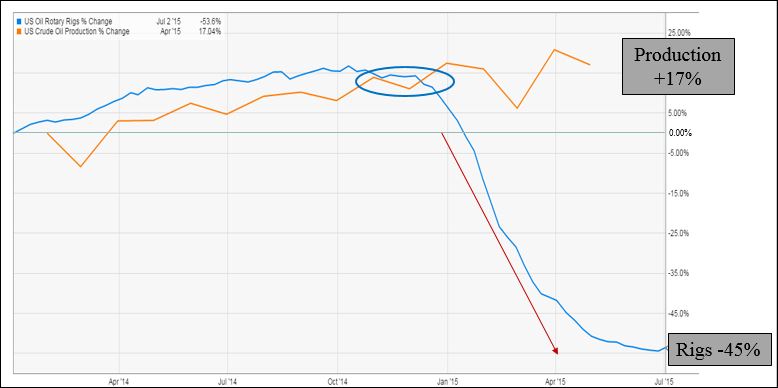
Earnings at energy-related companies are being socked by the 54% plunge in oil prices since their peak in July of last year. With the oil price drop, U.S. oil drilling has been cut back dramatically as seen in the rig and production chart below.

Market Reflection Rigs and Production 7 15_1

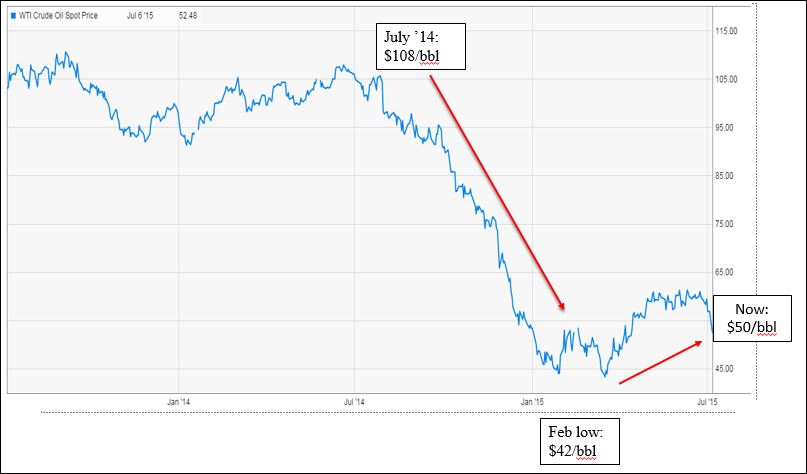
Oil production cannot be turned off like a faucet. Despite lower prices US production is still on the upswing, and inventories are near their 80-year seasonal peak. However, expectations are for volume declines beginning in the coming months, and oil prices are expected to remain around current levels or improve modestly, having already reach their lows in February. See the oil price chart below.

Market Reflecton Oil Prices_7-15_2

With major cost reductions in place and the steep drop in oil prices behind us, we anticipate that upcoming oil production drops would produce a tailwind to energy companies’ earnings over the coming quarters.

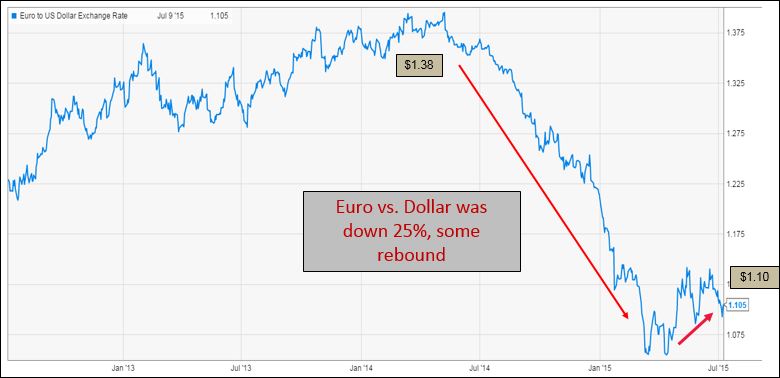
US-based global companies are being impacted by the strength of the US dollar versus foreign currencies over the past year. See chart below, noting the decline of the value of the Euro.

Market Reflection Euro Dollar 7 15_3

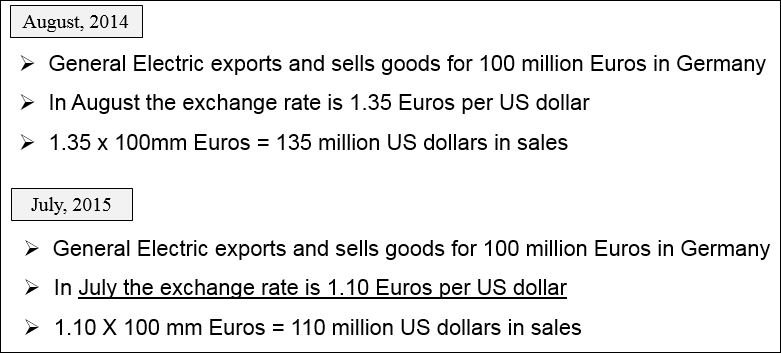
As US-based companies sell their products overseas, sales are impacted by the strength of our dollar. Locally sourced products & services appear more attractively priced to customers abroad when our dollar has increased in value. Most companies hedge their earnings, so the impact to earnings is not as severe as the sales impact, but both the sales and earnings growth trends can certainly be interrupted by these macro-economic conditions. The following example may clarify this.

Market Reflection GE Example Euros 7 15_4

The end result of such a scenario is that General Electric would record a 25 million year-over-year decline in US dollar sales.

The majority of this unprecedented broad-based currency re-valuation occurred in the second half of 2014. While further strengthening of the dollar is not out of the question, we expect overseas currencies to begin to show improvement, year-over-year, in the second half of 2016. This is due to efforts by overseas central banks to stimulate their economies. Imitating the success of the US Federal Reserve, the central banks of 22 other countries are currently in an easing mode. We expect them to show varying amounts of success based on factors specific to each country. In general, however, we anticipate that the US dollar will most likely stabilize, providing a tailwind to earnings for US multinational companies.

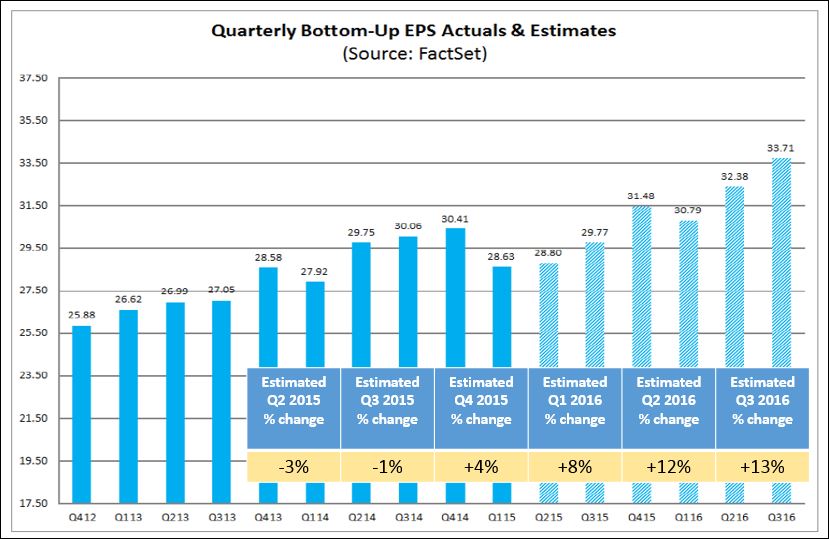
With these headwinds turning into tailwinds, consensus earnings estimates for the S&P 500 in the coming quarters are on the rise, from down 3% in the June ’15 quarter to down 1% in the September quarter to up 12-13% beginning in mid-2016. See chart below.

Market Reflection Pfd Bottom Up July 15_5

Current valuation for the S&P 500 stocks as measured by price/earnings is fair in our view. At 16.5 times forward earnings, they are above their 10-year average and toward the top end of the range, but nowhere near the peaks reached during the internet bubble of 2001-2002. We could get some multiple expansion as earnings growth accelerates. However, we would be more positive on any pullback in the market.


Posted on July 20, 2015 Read More

Q2 2015 – Market and Economic Review

Posted on July 16, 2015 Read More

News Archive