First Quarter Market Review

The first quarter was a wake-up call to all investors enjoying an extended period of higher stock prices, low volatility, and stable low interest rates. After multiple record setting stock market highs in January, the long awaited market correction became a February reality as stock prices fell 10% from their all-time highs. March provided additional price volatility as the market was left to negotiate a sea of cross currents.

The economic and political issues surfacing in the first quarter will continue to impact markets into and beyond the second quarter. The passage of corporate and personal tax cuts will provide fiscal stimulus to the economy. Simultaneously, the Federal Reserve is tapping the economic brakes by tightening monetary policy. The hot debate is whether there will be three or four rate hikes this year. The Fed raised the benchmark fed funds rate by a quarter percentage point to the 1.50-1.75% range in March.

The talk of tariffs and trade wars has the market on edge, adding to investor uncertainty. Quarterly corporate earnings releases will begin anew in mid-April. This round will be especially important as the market begins to reassess 2018 earnings estimates. The FAANG stocks (Facebook, Apple, Amazon, Netflix and Google/Alphabet), have provided long-term leadership to the stock market, and now these stocks are being stress tested. Geo-political risk is a constant worry, but tensions here are currently running high. Bottom line: expect market volatility to remain elevated.

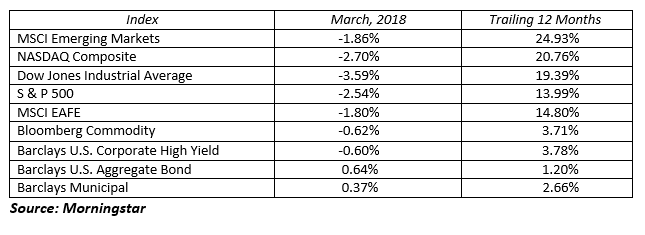
Despite all the noise and heightened anxiety, markets were down but not out in the first quarter. The Dow Jones Industrial Average endured two 1,000-point plunges but lost just under 2% for the three month period. This snapped a streak of nine consecutive up quarters for the Dow. Other major equity averages around the global were mixed for the quarter. The NASDAQ 100 and the MSCI Emerging Markets finished the quarter slightly positive while the MSCI EAFE and S&P 500 were slightly negative. From a sector standpoint, information technology +3.2% and consumer discretionary +2.8% were the biggest quarterly winners with telecom services -8.7% and consumer staples -7.8% the biggest losers.

In the bond market, prices declined as interest rates rose and credit spreads widened. For the quarter, the benchmark 10-Year U.S. Treasury yield jumped 34 basis points to yield 2.74%. The yield curve continued to flatten. The 2-Year Treasury rose by 38 basis points to end the quarter yielding 2.27%, while at the long end, the 30-Year Treasury rose 23 basis points to 2.97%. Despite the slow start to the bond market, we expect bonds to claw their way back to even by year end as future income will offset early year price declines.

Long-term investing is a marathon, not a sprint. In the big picture, the nine year bull market has done wonders for those investors with a long-term focus. Economic fundamentals are still very positive and can propel this market higher from here. Price corrections in the 5-10% range are normal and actually help create opportunities to buy at better valuations while providing further legs to bull markets. Stay patient, stay positive, stay invested.

MARKETS BY THE NUMBERS: 
To expand on these Market Commentaries or to discuss any of our investment portfolios, please do not hesitate to reach out to us at 775-674-2222
Posted on April 3, 2018 Read More

An Overview of International Stock Markets

International stocks can be a significant component of investor portfolio allocations. However, many of the differences between US and International stock market indices may not be widely known. In the following market reflection, we will provide an overview of international markets, including some of the differences in composition to US markets as well as a comparative analysis of performance.

What comprises “international stock markets”?

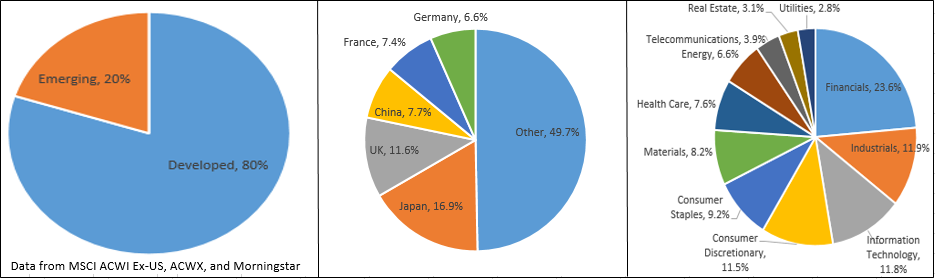
Simply stated, international stock markets are made up of all markets outside the US. A good proxy for international markets is ACWX, an ETF based on the MSCI All World Country Index, Ex-US. The following charts reflect data from the index and ACWX to compile a breakdown of international stocks.

Based on the above data, a few observations:

  • Developed markets (like Europe, Japan, Australia) represent 80% of the total international market
  • 5 countries (Japan, UK, China, France, Germany) represent 50% of international markets
  • China is, by far, the largest emerging market. It represents 38.5% of emerging market stocks
  • On a sector basis, Financials (23.6%) is the largest represented sector in international markets compared to Technology stocks (25.2%) being the largest sector in the S&P 500

Performance versus the US markets

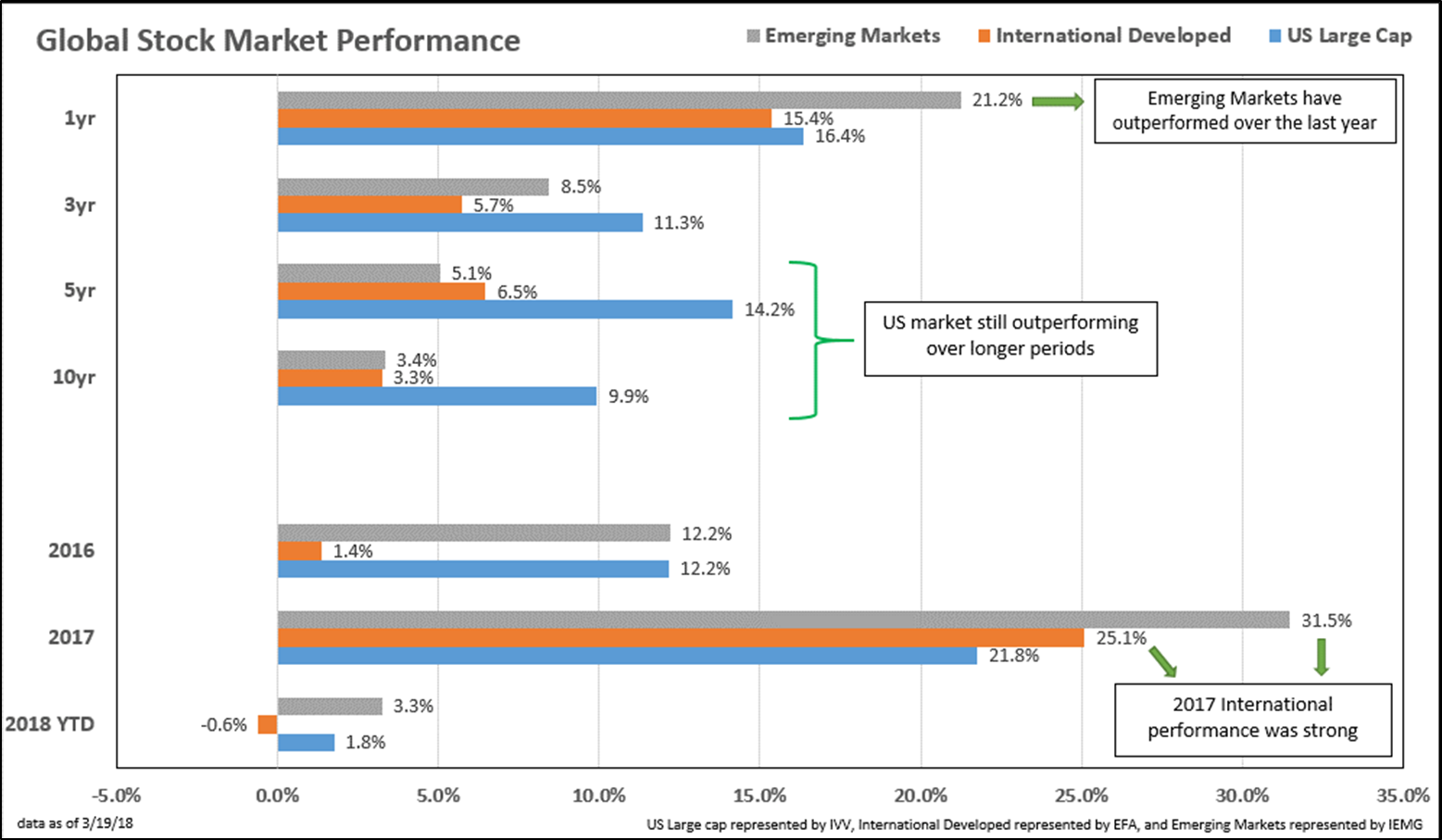
2017 was a strong year for international markets. The below chart reflects performance over several periods for US Large Cap stocks (blue bar), International Developed Stocks (orange bar), and Emerging Markets stocks (gray bar). International stocks, both developed and emerging, outperformed US markets in 2017. However, over longer periods, the US markets have outperformed international stocks.

International growth versus value

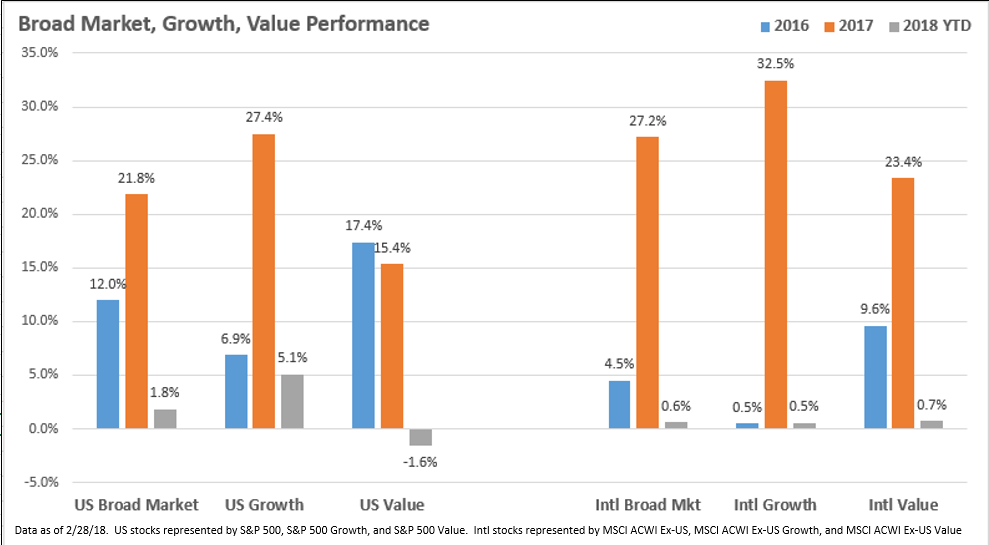
In regard to US markets, growth stocks have significantly outperformed their US counterparts in 2017 and into 2018. This trend has been seen in International markets as well. The below chart reflects performance of both US and international broad market, growth, and value stocks. In 2016 (blue bar), value stocks in both the US and international markets outperformed. In 2017 (orange bar), this trend reversed as growth stocks outperformed in both regions. Thus far in 2018, we have seen the same outperformance in growth in the US while the international stocks are more mixed.

Our international allocations and outlook

We are currently advocating for a balanced approach to US versus international stock allocations. While economic conditions and corporate earnings are favoring the US, valuations are favoring international stocks. Within our portfolios, there are several methods to gain exposure to international stocks.

  • The G40i provides growth and income from high quality, dividend paying international stocks. The G40i is a very strong complement to G50 allocations as the investment philosophy is similar, but is invested completely outside the US.
  • The ETF Endowment Series has allocations to international stocks across the conservative through growth spectrum.
  • The Gradient Tactical Rotation (GTR) invests in one geographic sub-sector through a rules based tactical strategy based upon price momentum. The current allocation is fully invested in Emerging Markets stocks

In closing, it is our belief that an allocation to international stocks can be beneficial for diversified growth in investor portfolios. We believe that providing various sources of portfolio return, which includes asset class, geographic locations, and sector diversification, creates long term portfolio benefits that may enhance returns and lower volatility over time.

To expand on these Market Reflections or to discuss any of our investment portfolios, please do not hesitate to reach out to us at 775-674-2222.


Posted on March 27, 2018 Read More

Trade Tariff Discussion

In early February, volatility returned to the stock market. Investor concern over rising interest rates and the fear of inflation were to blame for an approximate 10% peak to trough market correction. In early March, President Trump introduced a new set of trade tariffs; steel imports will be hit with a 25% tariff and aluminum imports with a 10% tariff. The tariffs will begin March 23rd and this has triggered another round of investor concerns.

Not only are investors concerned, but politicians (both Democrat and Republican), US trading partners internationally, and economists are raising concerns regarding:

  • This is a protectionist shift from the administration
  • The tariffs could spur retaliation (trade war) from our foreign trading partners
  • That tariffs will be a detriment to US economic growth
  • Consumers will face increased prices due to higher cost steel and aluminum
  • Rising costs for businesses that rely on the metals to manufacture their products

Traditionally, tariffs have not been positive for economic growth. They are a tax on imports designed to boost US production of goods. The idea is to push up the price of foreign goods to make the US-made option more attractively priced. In this case, the President is attempting to get companies to use more US produced steel and aluminum.

For many industries the cost to produce their goods will increase due to the tariff. Examples are beer, auto, home builders, oil and gas drillers and packaged food companies who all use steel and aluminum in the manufacturing process. These companies will either be forced to absorb the costs or pass the costs on to consumers. Either way, it’s a negative for corporate profit margins and/or an additional sales tax from increased prices for consumers.

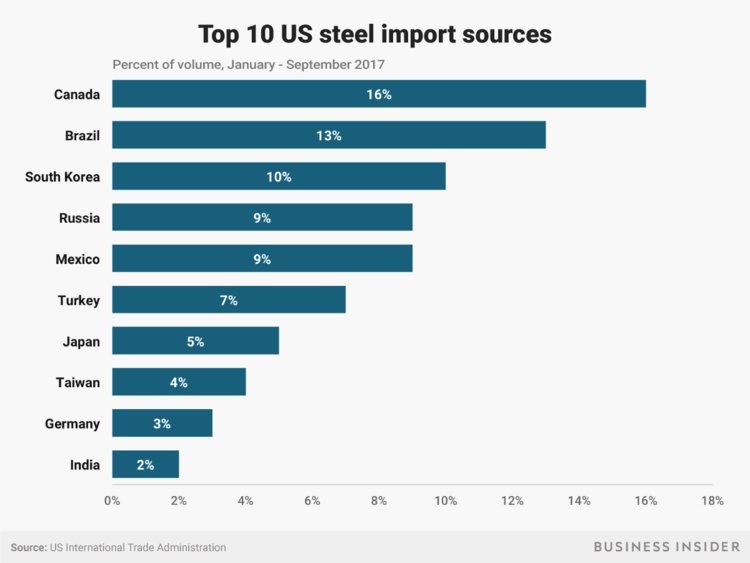
Additional harm could result if US tariffs sets off a global trade war as tariffed countries retaliate by imposing tariffs of goods the US exports to their country. At the least, this is likely to escalate trade tensions with our global trading partners. Below is a chart of the largest importers of steel to the US:

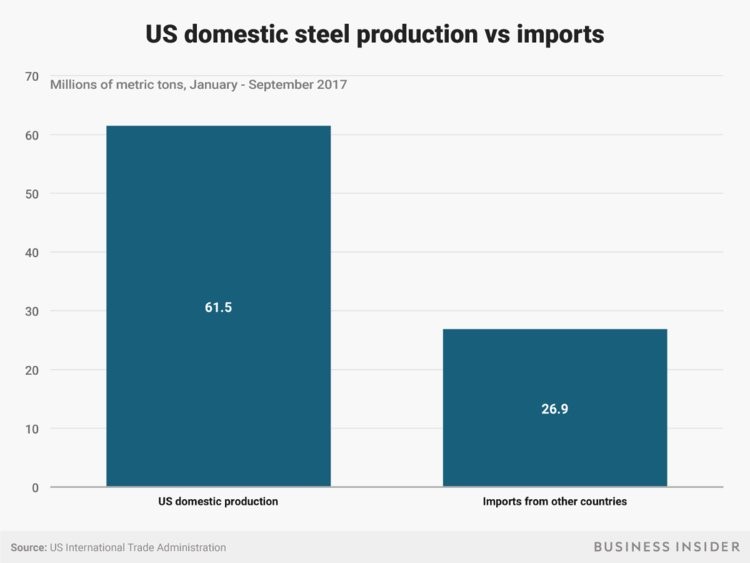
Mitigating this is the fact that the amount of steel produced in the US is far greater than the amount we import. See chart below:

Currently the tariffs are only on steel and aluminum. And the administration is already creating exemptions for Canada and Mexico from the tariffs, while other countries who are allies to the US can file for exemption. Many of the final details remain unknown, but if this is the extent of the tariffs, the impact on the economy and the stock market should be minimal. As further details on the US tariffs and retaliatory tariffs put on US goods emerge we need to closely analyze their effects.

Regardless of the extent of the current tariffs, any policy that detracts from free global trade is not going to be received well from investors. Wall Street will always be concerned about government policies that have the potential to raise costs for corporations, increase prices for consumers and slow the economy.

To expand on these Market Reflections or to discuss any of our investment portfolios, please do not hesitate to reach out to us at 775-674-2222.

Posted on March 12, 2018 Read More