U.S. Stocks: New All-Time Highs

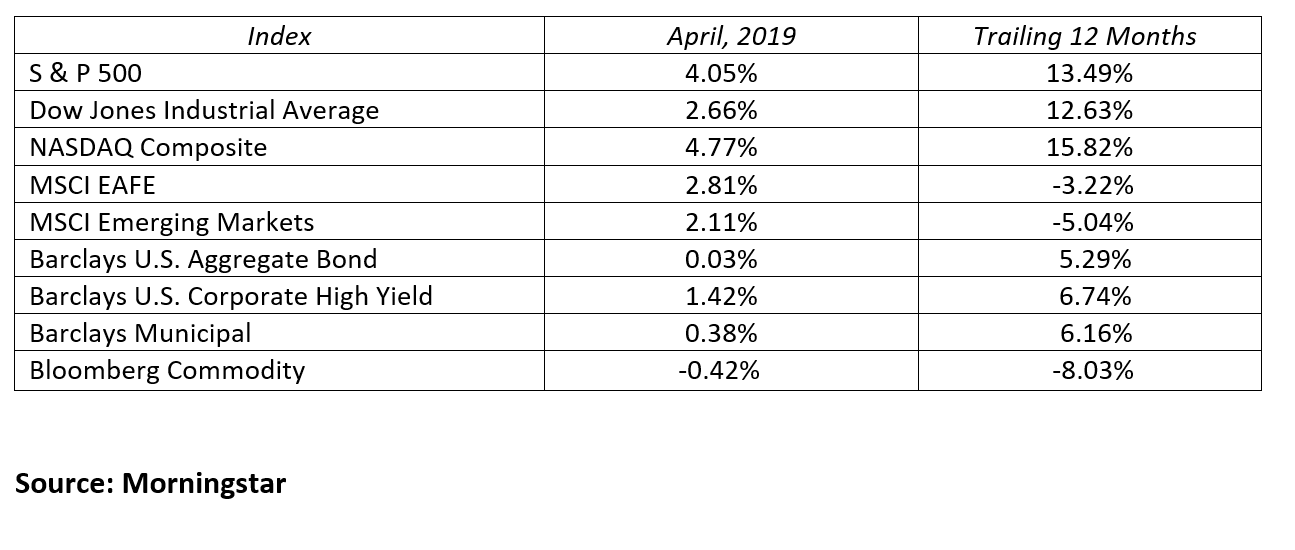
The fourth quarter pullback in stocks can officially be declared a correction as the 2019 version of this bull market took major U.S. stock indices to new all-time highs.  The Federal Reserve’s pivot to a dovish monetary stance in early January has paved the way for stocks and bonds to prosper.  The macro tailwinds from the economy and the Fed certainly help, but it is the individual company results that ultimately drive price.  As you can see from the market returns below, everything was positive for the month with the exception of commodities.  U.S. stocks continue to lead all global returns.

The first month of a new quarter means the market turns its attention to another round of corporate earnings releases.  This quarter’s earnings are especially significant as the market tries to judge the magnitude of the expected slowdown in earnings growth.  Wall Street is paying special attention to the company’s forward earnings guidance to better assess the full year 2019.

Companies reporting sub-par numbers are being punished by the market, while the winners are trading at all-time high prices. This month’s casualties included 3M, Intel, UPS, Alphabet and Exxon.  On the positive side, strong reports from Walt Disney, Microsoft, Facebook, Apple and JP Morgan fueled gains.   The early read on earnings is 78% of the S&P 500 companies have exceeded analyst expectations.  An active IPO (Initial Public Offering) market has also provided a bullish tone to equities and 2019 is expected to be a big year for IPOs.  April saw Lyft, Zoom Video, PagerDuty and Pinterest coming to the public market for the first time.  Other large private companies including Uber are expected to issue public stock this year.

On the economic front, first quarter GDP reported a 3.2% growth rate, well above the 2.4% expected rate.  The strong consumer is keeping us on solid footing as retail sales gained 1.6% in March, its largest gain since September 2017.  The March employment number was back on track as 196,000 net new jobs were created.  Monthly job growth averaged a respectable 180,000 jobs in the first quarter. Inflation, as measured by the Consumer Price Index, rose 0.4% in March.  This was the largest bump in 14 months mostly driven by higher gas prices.  The annual inflation rate at 1.9% is still running below the Federal Reserve’s 2-2.5% inflation target.

The bond market has been rock solid so far this year with the Fed calling a timeout to future rate increases.  The Fed’s move to a dovish monetary policy coupled with continued low inflation, declining global interest rates, a strong dollar and stable economic growth has kept credit spreads tight and interest rates stable.  The yield curve, while very flat by historical standards, is still hanging on to its positive slope.  The 2-Year Treasury note yield finished the month exactly where it started at 2.27%.  Meanwhile, the 30-Year Treasury bond added 12 basis points to yield 2.93%.  Most of the yield curve now has interest rates lower than the very short-term fed funds rate currently set by the Fed at 2.50%.  The benchmark 10-Year U.S. Treasury note again traded in a tight range hovering around 2.5%.  In April, the 10-Year rose 10 basis points to end the month yielding 2.41%. The slight uptick in rates this month should not be a surprise after the strong rally in March.

The question all of us ask is, where do we go from here?  Attention needs to be paid to corporate profits, future guidance and the path of the U.S. and global economies.  Investors are assessing the strength of the economy to determine if it is softening or strengthening relative to expectations.  At this moment in time, we believe the stock and bonds markets are priced appropriately.  Future catalysts, be they positive or negative will drive prices accordingly.  A trade deal with China, corporate earnings, Brexit, employment, inflation, the Federal Reserve and investor sentiment are all important.  If you are a long-term investor with a solid financial plan these concerns or opportunities become less important.  If you tend to be more emotional regarding market movements, these factors can be a concern.  An intra year 10% correction is very likely, so do not be surprised if there is one before the end of this year.  We are still positive on the long-term outlook and would encourage investors to also take a long-term approach.
To expand on these Market Reflections or to discuss any of our investment portfolios, please do not hesitate to reach out to us at 775-674-2222.
Posted on May 6, 2019 Read More

Recent Underperformance In Health Care

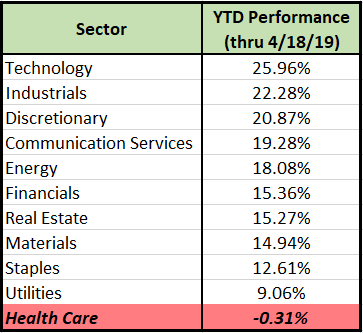
Thus far, 2019 has been a very strong year for stocks.  Year-to-date, the S&P 500 is up over 15% and international stocks are also up more than 10%.  While this has been a strong market in general, and many of the sectors have participated in the upside, the Health Care sector performance has lagged significantly.  Below is a chart that shows S&P 500 performance by sector year-to-date. *

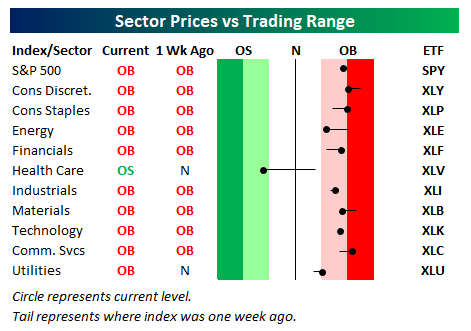
While Health Care has lagged all year, the weakness in the sector’s stocks has accelerated in the last few weeks.  The below chart, from Bespoke Investment Group, show that Health Care has diverged significantly from nearly all other sectors in the market.  Per Bespoke research, this type of occurrence is rare.  Since the early 1980’s, there have been only 10 other periods where one sector has traded at oversold conditions while all other sectors were overbought.

The primary concern in the Health Care sector has been political rather than fundamental.  Currently, there are a few widely-discussed initiatives that could have negative implications for Health Care companies.  Those include:

  • Medicare For All – a proposal that would cause significant changes to our current health insurance system
  • Drug pricing regulation – it has been suggested that this is one of the few bi-partisan issues which could see legislation that could be passed

Neither of the above initiatives have definitive policy or any clear mandate as of now but Health Care stocks have reacted, nonetheless.  Whether these initiatives ever see full-fledged enactment, and what the ramifications will be for Health Care companies, will have a large influence on their future performance.

*Source: Stockcharts.com

To expand on these Market Reflections or to discuss any of our investment portfolios, please do not hesitate to reach out to us at 775-674-2222.
Posted on April 29, 2019 Read More

First Quarter Review

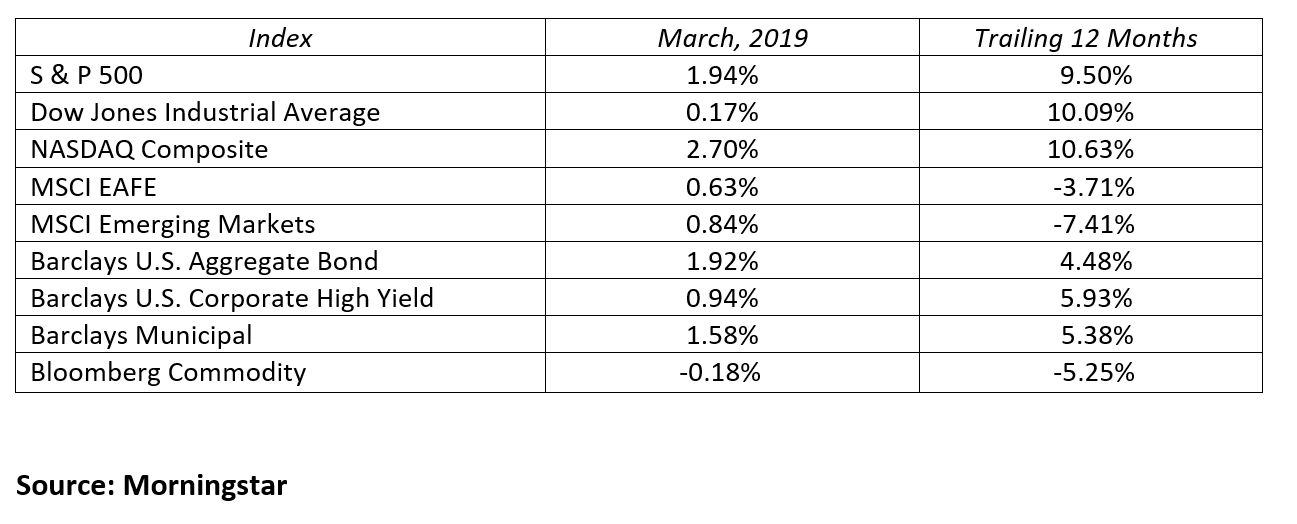
The first quarter was a welcomed turnaround for the financial markets following the fourth quarter setback.  The bull market reignited in late December and caught fire in January.  Momentum waned as the quarter unfolded, but each month produced positive returns for stocks and bonds.  For the three month period, the S&P 500 gained 13.7% and the Barclay’s Aggregate Bond Index netted 2.9%.

The Federal Reserve played a key role in the market reversal as they pivoted to a dovish position on monetary policy.  The year began with the market expecting the Fed to continue to raise the fed funds rate with regularity, but Chairman Powell proclaimed patience was the new path forward.  His statement was interpreted to mean zero interest rate hikes in 2019 and the markets immediately rallied.  The Fed’s new policy perspectives coupled with other encouraging news sent stocks soaring once again.

Fourth quarter earnings season was deemed a success with corporate earnings growing 13.4% making it the fifth consecutive quarter of double digit growth.  Future earnings growth will likely settle into single digit territory.  Employment data was exceptionally strong in December and January, but was offset by a disappointing 20,000 jobs created in February.  March’s employment number will confirm if this was a one-time event or a new trend toward less job creation.  The current 3.8% unemployment rate and growing wages still suggest a strong labor market.  The end of the government shutdown was another bullish catalyst.  A trade deal with China was anticipated all quarter, but now a deal is needed soon to meet market expectations.

The major stock indices had a great start to the year with U.S. stocks outpacing international stocks.  The bull market in U.S. stocks turned ten years old this March, a new historical milestone.   The NASDAQ Composite, S&P 500 and the Dow Jones Industrial Average had sizable gains of 16.8%, 13.7%, and 11.8% respectively in the first quarter.  Evidence of slower economic growth in international economies did not deter stock appreciation in those markets.  The MSCI EAFE and emerging markets indices still produced gains of 10.0% and 9.9% in the quarter.  This has been a traditional rally where growth and small capitalization stocks outperformed value and large capitalization stocks.

With stocks having a tremendous first quarter, one would expect bonds to be on the decline.  This was not the case as interest rates and the shape of the yield were remarkably stable to begin the year.  After the Federal Reserve meeting in March, the bond market rallied hard into quarter end.  The combinations of the Fed’s revised policy leanings, continued low inflation, declining global interest rates, and stable economic growth brought a new optimism to the bond market.  The Barclays Aggregate Bond Index gained 2.9% in the quarter.  High yield bonds, beneficiary of a strong stock market, led all fixed income sectors with a 7.3% quarterly return.  The benchmark 10-Year U.S. Treasury note traded in a tight range, then rallied, declining 28 basis points to end the quarter yielding 2.41%. The yield curve enjoyed a bullish flattening, as long-term interest rates fell more than short-term interest rates.  For the quarter, the 2-Year Treasury fell by 21 basis points to end the period yielding 2.27%.  Meanwhile, the 30-Year Treasury also fell 21 basis points to yield 2.81%.  Most of the yield curve now has interest rates lower than the very short-term fed funds rate currently set at 2.5%.

The financial markets are adept at stirring investor emotions through unexpected price volatility and price momentum.  The past three quarters provided a roller coaster ride from market highs to a double digit correction and back to market highs again.  Hopefully, you let your portfolio ride along while keeping your emotions on the sidelines.  The best approach to long-term investing is to stay invested at a portfolio risk tolerance that reflects both your financial goals and personality.   We are still optimistic on stocks and bonds for the remainder of the year.  After this very successful quarter, do not extrapolate these results through year end.  If stocks can add an additional 5% and if bonds can hold these gains, 2019 will be deemed a successful year for the financial markets.

MARKETS BY THE NUMBERS:

To expand on these Market Reflections or to discuss any of our investment portfolios, please do not hesitate to reach out to us at 775-674-2222.

Posted on April 11, 2019 Read More